Anyone new to the dog fancy who is just beginning to read breed standards may wonder why a particular trait is mentioned when it is an exceedingly rare occurrence in the breed. Some standards, for example, penalize “dogs not of an allowed color,” or list blue eyes as a disqualifying fault—even though blue eyes may be so unusual in the breed as to be virtually unseen in it.
Why mention something that hardly ever happens?
Standards are blueprints for how to “build a sound breed,” but unlike a house—where a creative owner may ask for something wacky—a dog is a living thing whose design is governed by anatomy, function, soundness, and genetics. Breed standards exist to define those limits, ensuring that novelty never comes at the expense of soundness, type, or purpose. Rare faults are written into standards to prevent drift—a tacit way of saying, “This must never become acceptable.” Such things do happen, of course, but not at the hands of scrupulous breeders invested in producing the next generation of structurally and temperamentally sound puppies. In that regard, standards are as much instructive as preventive documents.
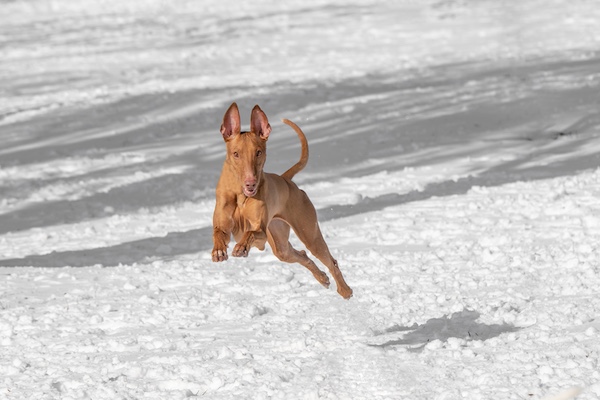
We pivot to an ancient sighthound, the Pharaoh Hound, to provide another example. Developed to hunt rabbits on rocky terrain in Malta, the Pharaoh’s AKC breed standard describes the tail as well carried, curved when in action, fairly thick at the base, tapering whip-like, and reaching below the point of hock in repose. It should not be tucked between the legs. Pretty straight forward, no?
But then it adds: “A screw tail is a fault.”
Most dog people know that sighthounds use their tails as a rudder and counterbalance during fast, agile turns, a long flexible tail helping maintain balance. We’d show you a photograph of a screw tail in the Pharaoh Hound but we couldn’t find one, nor have we ever encountered one in many decades of involvement in the sport. We defer to the authors of the standard, however, for including it because even though a screw tail is exceedingly rare, Pharaoh Hound enthusiasts mean to keep it that way in a breed that has a relatively small global gene pool. Screw tails are typically associated with congenital vertebral malformations usually caused by abnormally shaped caudal vertebrae that formed only partially; the presence of one suggests either an undesirable genetic influence, or a deviation from correct skeletal development. A screw tailed Pharaoh Hound may make a lovely companion, but responsible breeders know that such a tail compromises functional balance, disrupts the correct Pharaoh outline (and thus, breed type), and conflicts with the breed’s historical and genetic identity. This isn’t just the AKC saying it. The United Kennel Club, The Kennel Club in the UK, and the FCI all fault a screw tail in the breed.
Taken together, these examples underscore that breed standards are not arbitrary rulebooks or historical curiosities, but carefully constructed safeguards. By naming even the rarest deviations, standards articulate not only what a breed should be, but what it must never become—ensuring that soundness, function, and identity are preserved for generations yet to come.
Photo of Pharaoh Hound by Julian Popov/Dreamstime