It’s jokingly said that if you remember the ’60s, you weren’t there. Conversely, if you remember Andy Warhol, you were probably of the generation that knew the Velvet Underground, understood the fuss over a painting of a Campbell’s soup can, and recognized the man who said, “In the future, everyone will be world-famous for 15 minutes.”
Warhol grew up with cats, but in the early 1970s, his boyfriend, Jed Johnson, persuaded him to get a dog.
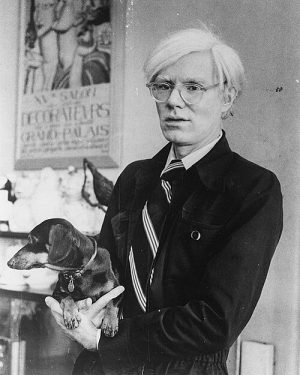
That dog was a Dachshund named Archie, and Warhol was besotted. Archie went everywhere with him: art openings, Studio 54, restaurants, and even press conferences. Warhol reportedly hid the little dog when a health inspector appeared at a restaurant, and he described Archie as his “alter ego.” If Warhol was asked a question he did not like, he would toss it to Archie instead, using the dog to deflect it.
Warhol would not even consider traveling to London if it meant leaving Archie behind—or subjecting him to the then-required six-month quarantine. Archie was not simply a pet; he was a constant companion, a fixture in Warhol’s public life, and, in many ways, one of the personalities in his orbit.
Warhol and Johnson expanded their “family” when they acquired a second Dachshund, Amos. Amos was described as a more conventional dog than Archie, who apparently preferred the society of people. With Amos in the household, Warhol felt more comfortable leaving the dogs behind, knowing they had each other for company.
Andy Warhol makes a fine subject for NPDD because the dogs in his life were largely purebreds—and because he treated them much as he treated the celebrities, collectors, musicians, and hangers-on who populated his world. Archie arrived in 1972 and soon appeared in Warhol’s life, his studio, and his art. Warhol included him in the silkscreen Jed Johnson with Dachshund, created around 1973.
When Amos joined the household a few years later, Warhol painted the puppy at least a dozen times in early 1976 alone, producing acrylics and screenprints in full Pop Art color. Between the two Dachshunds, roughly 20 of Warhol’s works are Dachshund portraits.
But Archie and Amos were only the beginning.
After Warhol painted a portrait of Ginger, a Cocker Spaniel belonging to a prominent art collector, his manager and agent suggested that he paint an entire series of dogs—and cats. He did. Warhol ultimately painted more than 70 dogs and cats belonging to friends, acquaintances, and collectors.
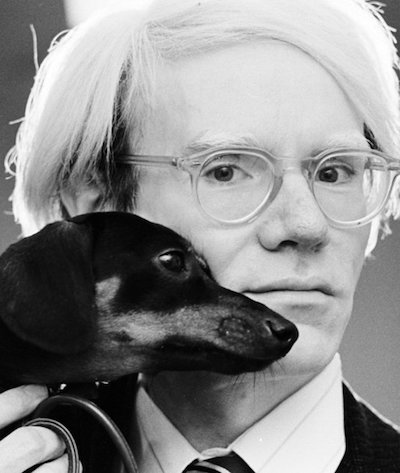
Andy Warhol with one of his Dachshunds, Archie by
Jack Mitchell CC BY-SA 4.
The resulting Dogs and Cats series remains among Warhol’s lesser-known bodies of work. It includes silk-screened portraits of a Great Dane, West Highland White Terrier, Dachshund, Boxer, Cavalier King Charles Spaniel, and Cocker Spaniel, among others. The paintings are unmistakably Warhol: boldly colored, graphic, stylized, and as interested in the animal’s personality as in its appearance.
Interestingly, Andy Warhol and his Dachshund became the subject of another famous artist, Jamie Wyeth. “He’d come down here”—to the Pennsylvania farm where Wyeth lives—“for the weekend,” Wyeth recalled in an interview with The New York Times, “but I don’t think he was too crazy about the country.”
As for our post title, Warhol was once described as the art market’s Dow Jones and as a “bellwether of the art market,” and for good reason. In 2017, Andy Warhol works generated $286 million in auction sales. Thirty-two years after his death, 1,271 Warhol objects sold at auction, with an average sale price of $1.3 million.
For all the money, celebrity, and mythology surrounding Andy Warhol, however, there is something especially appealing about the image of him with Archie and Amos: the famously detached artist, devoted to two small purebred dogs who were never far from his side.
Top photo of Andy Warhol and his Dachshund, Archie, at his New York studio, the Factory in 1974. The photo is in the public domain in the United States because it was published in the United States between 1931 and 1977, inclusive, without a copyright notice.