You saw what we did there, right? “Croup, There it is?”
No?
You didn’t hang on every word of the 1993 hip hop song, “Whoomp! (There It Is)” by Tag Team?
Pun aside, we get down to business by sharing segments from a few AKC breed standards to introduce our topic which is (wait for it), the CROUP!
- Golden Retriever: The AKC standard states that a “flat or steep croup” should be faulted, highlighting the importance of a properly sloped croup for correct movement and balance;
- Coton de Tulear: The standard specifies that a “steep or flat croup is to be penalized,” indicating that neither extreme is desirable for the breed’s structure and function;
- Herding Breeds: The AKC herding group standards also note that a flat croup is a fault and should be penalized in the show ring;
- German Shepherd Dog: The ideal croup is described as “long and slightly sloping (approx. 23° to the horizontal),” with a flat croup being considered a deviation from the standard;
- Doberman Pinscher: The standard calls for a “slightly rounded, well filled-out croup,” and a flat croup would be considered incorrect.
Specifically, our topic is the “flat croup,” and as you may have gathered from the text above, it is undesirable in many breeds. But what is it, and why is it a bad thing?
First, we need to know where the croup is on a dog. Follow the arrow:
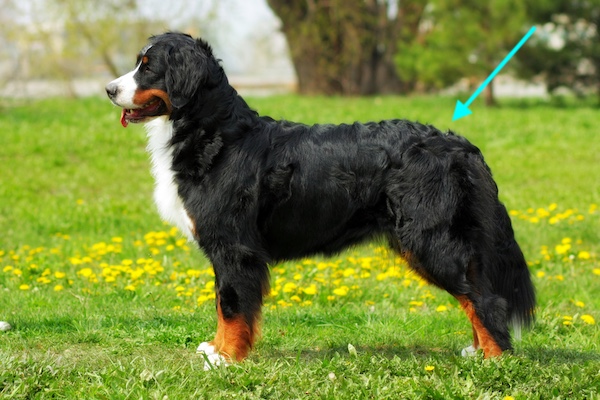
Photo of a Bernese Mountain Dog by © Garosha/Dreamstime
Next, what is a croup? It is a part of the back immediately in front of the tail.
And why is it important? The angle of the croup decides how the tail is set on a dog, and the tail is important because it plays a vital role in movement and balance as a counterweight for agility and stability.
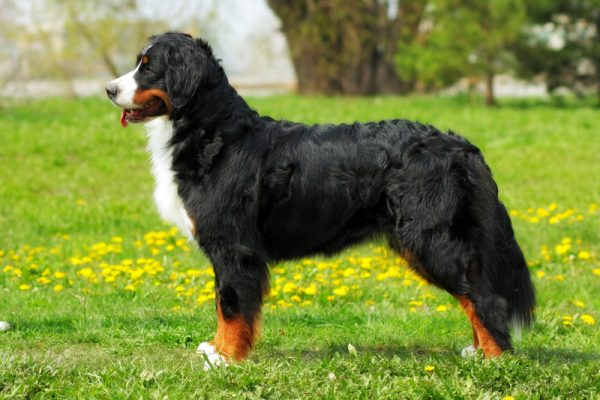
Normally, this area should slope gently downward from the back to the base of the tail. When the croup has a gentle, rounded slope as seen in the Berner above, it flows smoothly from the back. If the croup slopes down more sharply, the tail is set lower, and the steeper the angle, the lower the tail will be. That said, and regardless of the breed, extremes in either direction are to be avoided. Overly rounded or overly steep croups can lead to issues with balance, and then with compensation. When there’s extra strain on the joints in a dog’s back legs, it puts more downward force on the croup. This increased pressure can lead to an unnatural curve in the spine, making the dog more likely to develop lower back issues. And because dogs rarely complain, they may suffer in silence.
On the other hand, a flat croup can make the dog’s back stiffer and change the angle of the hip socket; some dog people believe this can raise the risk of hip dysplasia by altering biomechanics that may place more strain on the hip joint, and predispose the dog to wonky hips, but we defer to experts on this point…..
What is more certain is that a flat croup often leads to a high tail set and can limit the backward extension of the hind legs, reducing the dog’s ability to generate powerful propulsion from the rear. The tail is set higher, and that can limit how far the back legs can stretch out behind them – and that makes it harder for the dog to push off from her rear, so her gait isn’t as strong or efficient—something that’s a big deal for dogs that need to work or compete. A flat croup tends to make the back stiffer, so the dog’s spine doesn’t flex as easily, and that can lead to lower back issues and throw off the dog’s balance. This all adds up to more strain on the body, especially for breeds that rely on powerful rear movement to do their jobs well.
Much of what we know about the structure of dogs comes from the horse world, and the best illustration we found of a very steep croup next to a very flat croup is of horses. Though a different species it’s still relevant to dogs because the basic principles of croup structure and its impact on movement and function are similar across quadrupeds. Both dogs and horses rely on the alignment and angle of the croup—the area at the top of the hindquarters just before the tail—for efficient movement, balance, and power.

But in a hairy breed like the Pomeranian, how can anyone tell what the croup is doing? In part, a judge does it by running their hand from the dog’s back over the croup to the tail base to determine whether the croup is flat, sloping, or steep, and how the tail is set and carried. This is especially important in a fuzzy furry breed where coat trimming and grooming by gifted groomers can create the illusion of a proper or improper croup. Only touching can reveal the truth. And to verify what the judge’s hand felt, they move the dog to observe the dog’s gait from the side and behind. Proper tail carriage and efficient movement suggests a correct croup.
Bottom line: A flat croup is a structural fault in most breeds, so it’s important to know your breed standard and learn structure!