
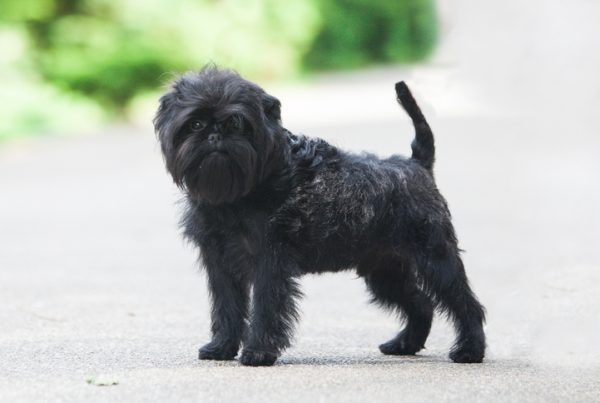

We’ve come this far to explore what reads like a paradoxical line out of the Affenpinscher’s AKC breed standard: “The Affenpinscher carries itself with comic seriousness.”
As we read this, we found ourselves with a paradox which might be at the heart of the breed: Is “comic seriousness” a window into the Affenpinscher? We share a couple of video snippets as an illustration:
The dog is, of course, Gr Ch Banana Joe v Tani Kazari handled by Ernesto Lara, and in “Joe,” we see a dog certain of his relevance in the world. A quizzical, monkey-like expression is comic enough to elicit our smiles, but it is a little at odds with his air of importance: He knows something profound, and we don’t. The effect is unintentional humor wrapped in confidence.
Again, we’ve all seen a dog – maybe even our own – who responds to words of praise, applause, and delight, but the question remains— do they know what the laughter and clapping mean? Science, so far, steps back before answering in the affirmative. Dogs respond to applause and laughter as positive, often exciting stimuli; they may wag, bow, or preen, scanning human faces for cues, but the deeper mystery of inner motive is theirs alone.
Personal experience is hard to dismiss out of hand. If the crowd’s cheer spurs a dog like Bean to offer up his signature sit, or we catch an Affenpinscher basking in delighted scrutiny, some part of us wants to credit them with being “in” on the joke even when experts remind us that dogs don’t experience embarrassment or pride as we humans do. In short, dogs aren’t self-aware in the same way we are.
We’re honestly not so sure. So many dogs seem to have an ability to read the room and lean into the moment.
Is the Affenpinscher, then, the embodiment of this contradiction?
And how astute were the writers of the breed standard to coin “comic seriousness” as the perfect shorthand to describe a breed so earnest in their importance, while wearing a quirky “monkey” mask that is beyond adorable?
We suppose that in the end, the Affenpinscher is a reminder that what we perceive in our dogs is part projection, part observation, but it is hard not to believe, if only just a little, that Affenpinschers and their humans are partners in the same joke.
Image by Ilona Didkovska/iStock