
There is a truism in dogs that when you control the head, you control the body. This is why head collars, such as the Halti and Gentle Leader, work.
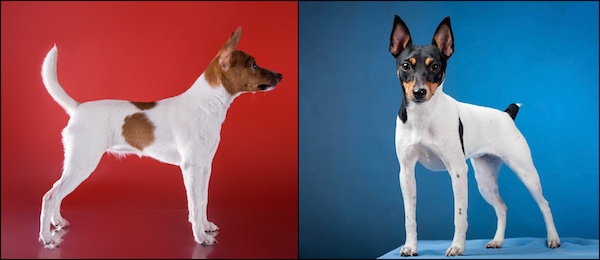
Switching seamlessly to conformation standards (winkie winkie), there is a breed in which the head (color) controls the rest of the body, and that is the Toy Fox Terrier. Body spot colors always match the head’s base color (not the tan points). Therefore:
- A Tri-Color’s head is mostly black with distinct tan markings on the cheeks, lips, and above the eyes. The body, over 50% white, may be with or without black spots;
- In a White, Chocolate, and Tan dog, the head is mostly chocolate with distinct tan markings on the cheeks, lips, and above the eyes. Body is over 50% white, with or without chocolate spots;
- A White and Tan Toy Fox Terrier’s head is mostly tan. Body is over 50% white, with or without tan spots –
- and in a White and Black dog, the head is mostly black.
Why?
Because in Toy Fox Terriers, the body spots and head are both determined by the dog’s base pigment, which is controlled primarily by the B locus (black vs. chocolate). This locus sets the dog’s main color—black, chocolate, or tan—that appears wherever pigment is expressed.
The tan points on some dogs (like markings on the face, legs, or under the tail) are controlled by the A locus (agouti gene). These points are simply an overlay on the base color and do not change it.
White areas on the body are caused by the S locus (spotting gene), which prevents pigment from being expressed in certain patches. Wherever a body spot appears within the white, the color that shows is determined by the head’s base color, not the tan points.
In short: the head reflects the dog’s base pigment (B locus), tan points are separate markings controlled by the A locus, and body spots are mini “head-colored patches” appearing in areas where the S locus allows pigment. That’s why body spots always match the head, not the tan.
Dog shows can be baffling to children and adults outside the fancy, but making little games out of the experience can transform it into enjoyable fun. For example, challenging a child to spot a Toy Fox Terrier whose body spot doesn’t match the head color not only keeps them engaged, it also creates a perfect “teachable moment” about breed standards—since they’re highly unlikely to find such a mismatch in Toy Fox Terriers.
Our image shows only two of the aforementioned colors, but it gives a sense of the body spot matching the head.
Collage Image: The Chocolate/Tan TFT is by © Annaav/Dreamstime; The tricolor is by Farinosa/iStock