
Few readers of these pages don’t cringe when a small child sits on the back of a large dog, but there is a scenario in which it is acceptable, and that is on a spinning ride known as a carousel or merry-go-round.
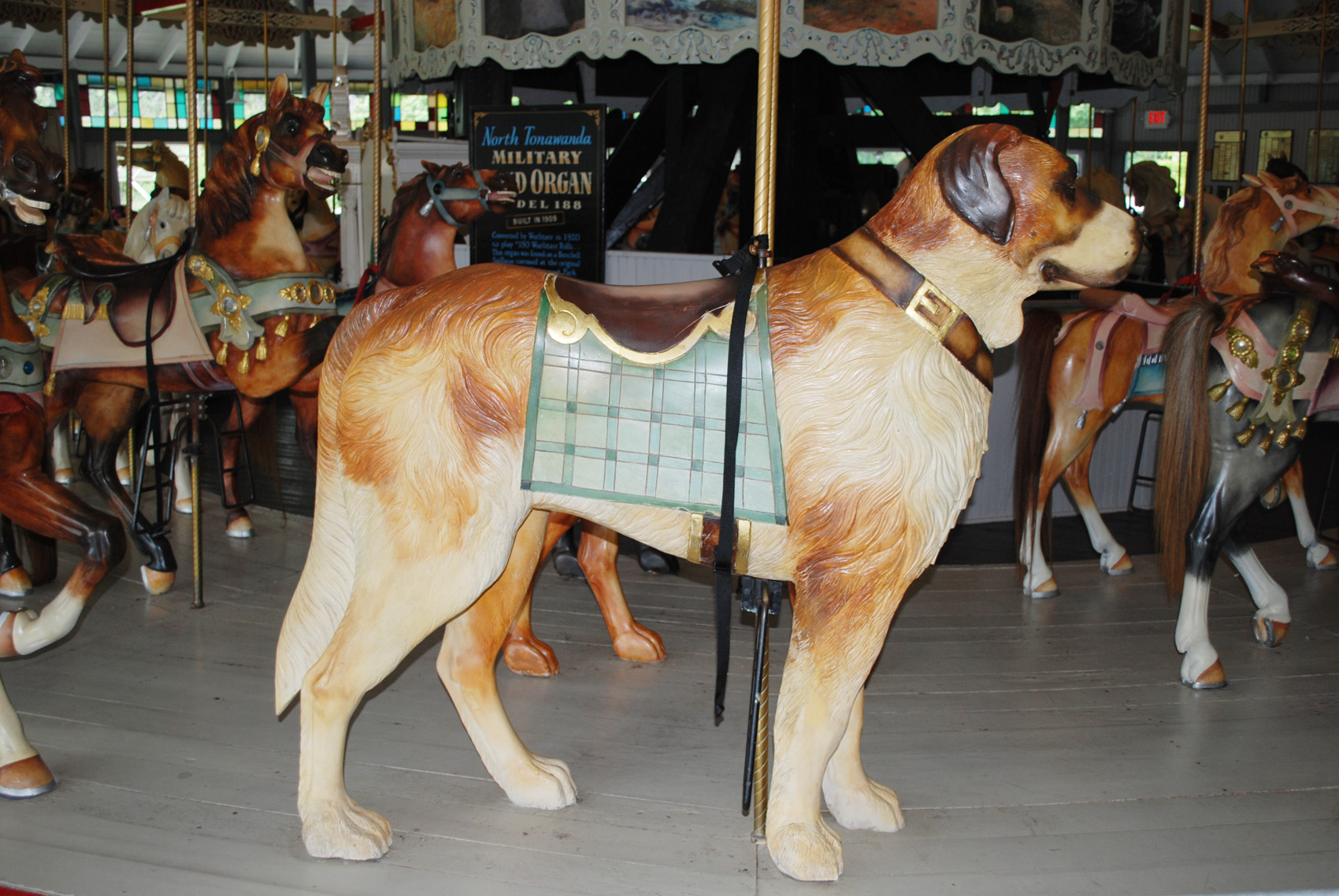
Historically, colorfully painted horses have dominated these amusement rides, but occasionally, other animals have taken their place among the equines, and the dog was among them. During the late 19th and early 20th centuries, when American and European carousels reached their golden age, artists like Gustav Dentzel, Herschell-Spillman, and Charles Looff expanded beyond horses to create menagerie carousels that featured lions, camels, frogs, pigs – and yes, dogs of different breeds. They appeared in a range of breeds and attitudes: the poised Greyhound, the loyal Collie, the playful Spaniel, and the noble St. Bernard. Each reflected the sculptor’s attempt to capture the dog’s devotion and spirit.

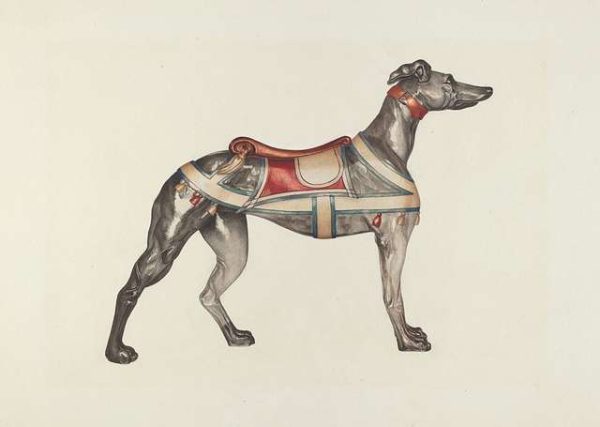
Drawing of a carousel dog from the 19th-20th century via public domain
The Herschell-Spillman Company of North Tonawanda, New York was active from about 1900 to 1920 during which time it produced numerous carousel dogs, including one still operating on the 1913 Herschell-Spillman Carousel at Greenfield Village, housed today at The Henry Ford Museum. Other examples include life-sized wooden dogs by the Philadelphia Toboggan Company, with one Saint Bernard known as “Bruno” inspiring modern carvers. Although only a small percentage of carousel figures were dogs, their presence lent character and humor to the rides, contrasting the heroic energy of horses with the charm of faithful companions.
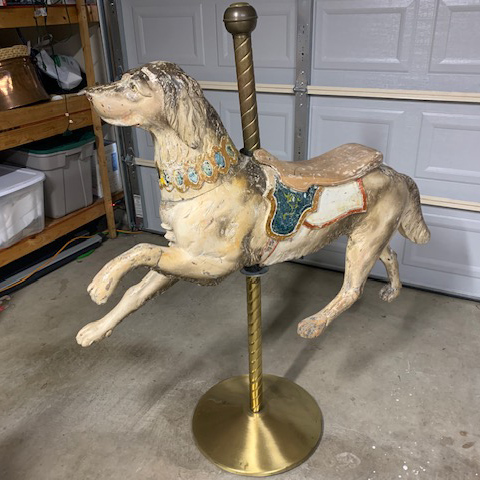
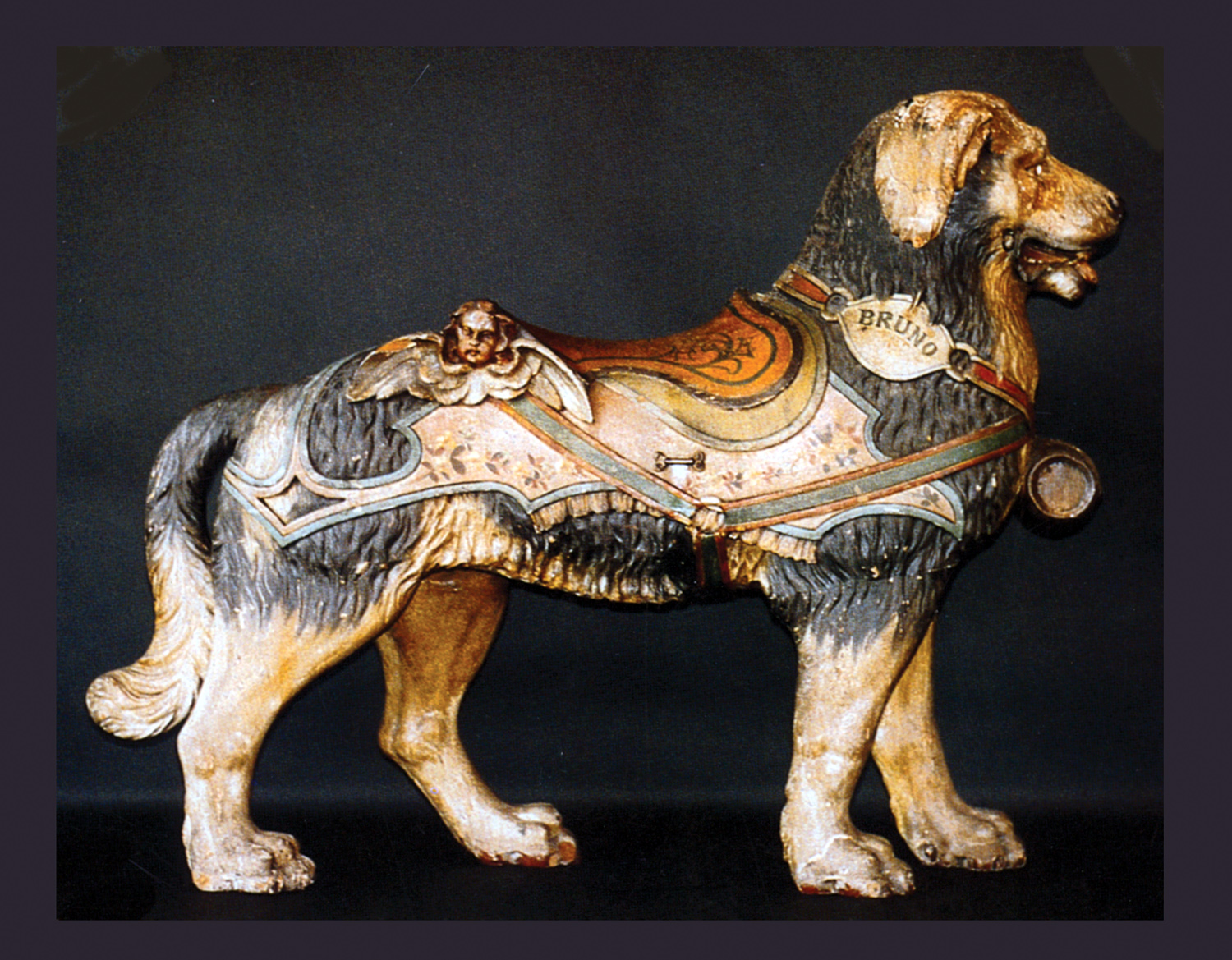
Carvers typically placed dogs on inner rows, reserving outer positions for elaborate horses that drew spectators’ eyes. Most were carved from laminated basswood or linden, with intricate painting and gilding to accent features like collars and harnesses. Each figure represented the artistry of immigrant craftsmen blending European carving traditions with American exuberance in color and form.
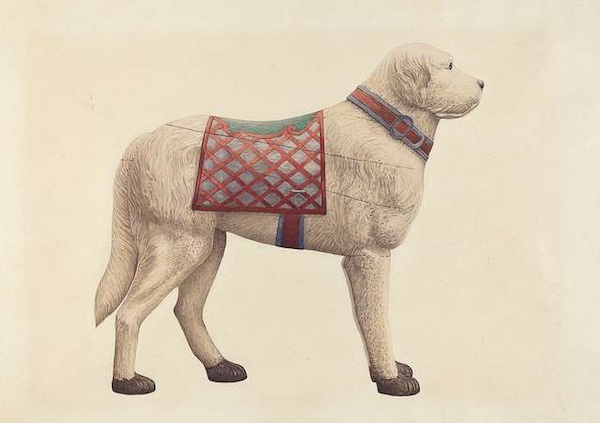
Drawing of a carousel dog from the 19th-20th century via public domain
As an aside, while “carousel” and “merry-go-round” are often used interchangeably, the terms developed differently on each side of the Atlantic. In North America, carousel refers to the ornate, motorized amusement ride with animals that move up and down. In the United Kingdom, merry-go-round traditionally described the same ride, but turning in the opposite direction—clockwise rather than the American counterclockwise—and the word later came to describe simple playground spinners as well. Thus, all carousels are merry-go-rounds, but not all merry-go-rounds are carousels.
By the 1930s, industrialization and the Great Depression all but ended the age of hand-carved wooden animals, and finding a carousel dog is now a collector’s dream. According to auction records and dealers, an antique Herschell-Spillman or Philadelphia Toboggan Company (PTC) carousel dog can sell for anywhere between $2,500 and $25,000, depending on rarity and craftsmanship. For example, a mid-20th-century Spanish carousel dog was recently priced at about $2,747, while an early 20th-century American folk art dog chariot panel from a carousel sold for $6,000. Youza.
High-end sales of carousel dogs, particularly those attributed to famed carvers like PTC, can reach even greater heights. A PTC St. Bernard carousel dog sold for $174,000 at auction in the early 1990s, setting one of the top prices ever achieved for a carousel figure. Similar hand-carved pieces from well-known workshops such as Dentzel or Looff have sold in the five- to six-figure range, depending on originality of paint and overall preservation. Needless to say, then, that authentic carousel dogs are highly collectible!
We found no evidence that a full-sized, public carousel ever featured only dogs, though artists have created miniature “dog-only” carousels for collectors.
If the topic interest you, there are a number of websites where you can see more examples of carousel dogs, including the Henry Ford, and Carousel History as seen below:
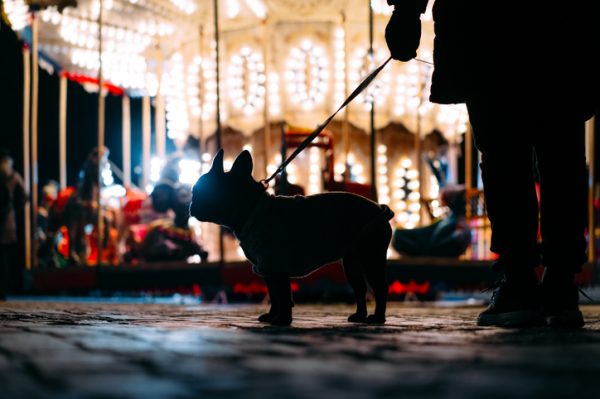
Top image of a Frenchie by Adriana Duduleanu/iStock was taken in Bucharest, Romania