Unless one is a breed fancier or the breeder of a particular breed, one doesn’t always pay attention to the “connective” parts of a dog. By this we mean those bits that connect one part to another: the loin that connects the rear assembly to the chest; the pasterns that bridge the feet and legs; and the strong, well-let-down hocks that link the second thigh to the rear pastern. Even the tail set, which ties the spine to the rear outline, plays a critical role in balance and overall symmetry. Mind you, they are all important, but not necessarily the things that get the attention of a casual dog person.
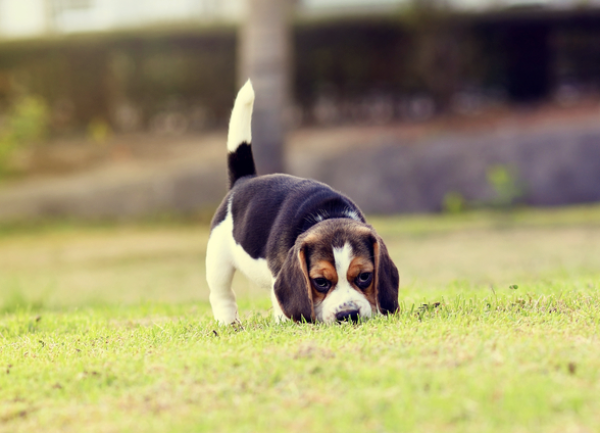
We use this post to talk about another such “connective piece,” the neck, and in particular, the neck of a Beagle. Obviously, the neck holds up the head, but in the Beagle’s AKC standard, the neck and throat account for 5% of the scoring in evaluation, and it has an important role to play beyond being a head pedestal. It impacts how a Beagle does his job as a hunting scenthound. Let’s take a look at some of the wording from the standard:
Neck and Throat: Defects: A thick, short, cloddy neck carried on a line with the top of the shoulders. Throat showing dewlap and folds of skin to a degree termed “throatiness.”
If a neck is too short and thick (or “cloddy”) the dog will have trouble keeping his head to the ground for long periods of time without tiring quickly – a disadvantage during long hunts. It will restrict flexibility, and this will impede the dog’s ability to dodge branches, pivot around obstacles, and maneuver through rough terrain. A short, thick neck level with the shoulders forces the dog to carry his head too high or stuck out horizontally more like a terrier. It lifts the nose several inches off the ground and reduces the dog’s ability to pick up faint, low-lying scent particles. The neck has to be long enough for his sniffing nose to reach the ground without forcing the dog to crouch the entire time he’s on the hunt.
As for “throat showing dewlap and folds of skin (throatiness),” these are unwelcome traits for a couple of practical reasons:
Seed heads and other vegetative debris can collect in the folds and irritate the dog to distraction (or worse). Environmental moisture can lead to skin irritation, the risk of fungus or infection, and again, reduce efficiency while scent trailing. A “clean” neck allows air to flow freely which allows better air intake of scent-laden air, thereby optimizing tracking performance during the steady, distance-eating trot for hours that Beagles on a hunt are expected to do. And since they rely on panting to cool themselves, heaviness of skin on the throat and a pronounced dewlap can slightly impede airflow and reduce the surface area available for evaporative cooling. When it’s warm or in humid conditions, a throaty Beagle will overheat faster than a clean-throated one. Guess which one makes it to the end of the hunt?
These are not new concepts.
Field reports that appeared in Beagling by G. O. Shields in the late 19th century decried “terrier-like shortness” for preventing efficient trailing.
In 1934, W. Lewis Parker critiqued “coarse” necks and “throaty” builds as liabilities in trials in his book, The Beagle.
Kennel notes from the Fernie or Quorn hunts before the 1940s warned against “bull-necked” or “dew-lapped” hounds that “tire in the thick,” and American Beagle Field Trial annuals from the 1920s–1940s (and archived by the AKC) include judges’ critiques like, “No account of merit for the cloddy-throated entry.”
In short, a Beagle with neck faults is less efficient at hunting. He may tire sooner, track less accurately, and have less endurance. A show judge mindful of the standard honors it by rewarding a structurally sound dog with a good neck.