
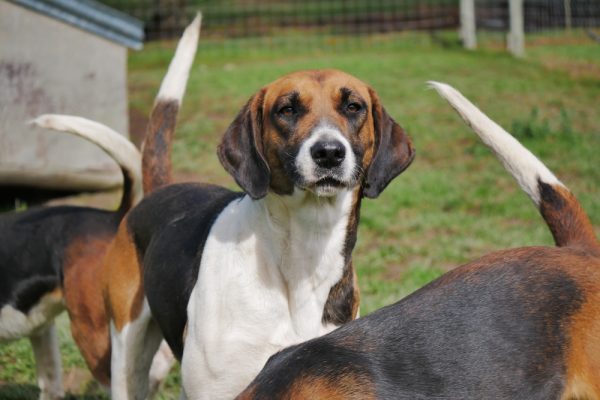
Are you familiar with the Southern Hound?
This heavy-set, square-headed dog is characterized by remarkably long, velvety ears that sweep the ground to stir up scents that get trapped by a prominent dewlap. It is the master of the “cold nose,” which is to say it can track old trails, albeit slowly as it works with a methodical pace.
And we just “finessed” the truth with you. No one alive has ever seen a Southern Hound because it is extinct. Unlike dinosaurs that some paleontologists theorize were “offed” by a single large asteroid impact, the extinction of the Southern Hound wasn’t a sudden event, but a gradual “fading out.” The breed had begun to lose its footing in the mid 18th century as the industrial age was dawning; the English countryside was getting carved up by enclosures, and hunting shifted from the slow, social tracking of deer and hare to the high-speed, adrenaline-fueled chase of the fox. The Southern Hound had become too slow for a generation that now demanded quick sport. The breed was being “bred into oblivion” by using it almost exclusively to improve other lines, and finding specimens, let alone pure Southern Hound packs, had become rare if not impossible.
Why we’re talking about a vanished breed is because the Southern Hound’s DNA is the foundation for almost every modern scent hound known today. It is the genetic bedrock of the Bloodhound’s nose, the Coonhound’s endurance, and the Beagle’s voice, but its most balanced successor is probably the Harrier.
Why? Because the Harrier occupies a functional middle ground. The Bloodhound leaned into the Southern Hound’s heavy features, and the Foxhound prioritized raw speed, but the Harrier is the perfect balance. The “vanished” traits of the Southern Hound weren’t just preserved, they were optimized in the Harrier. Because it is neither too slow to be practical nor too fast to be thorough, it is a living bridge between the ancient forest trackers of old England and the athletic sporting dogs of today. It retains the legendary cold nose and scenting intelligence of its ancestor, and the loud, carrying pack voice, but with the stamina and agility to navigate hills and dales at a brisker clip.
We regret the loss of any breed, but at least the Southern Hound’s spirit was refined and preserved in the Harrier, a breed some think is the quintessential specialist for the hare hunter. That said, we especially lament the fact that the Harrier is currently considered one of the most at-risk and endangered dog breeds in its home country. Once a staple of the British countryside, its numbers have plummeted to critical levels. In 2023, zero registrations were recorded with the UK Kennel Club, and in 2024, only one Harrier puppy was registered (for context, The Kennel Club considers any breed with fewer than 300 registrations per year to be “vulnerable”).
Why has this happened to a terrific breed? We can only surmise that it is the result of a “perfect storm.” As pack hunting has declined or faced legal restrictions, the demand for the breed has vanished. With so few individuals registered outside of working packs, keeping a healthy, genetically diverse population is increasingly difficult for the few dedicated breeders left. And finally, the general public isn’t aware of a breed that is sometimes mistaken for being an “oversized Beagle” or “small Foxhound.”