When we dive into the history of American working dogs, the term “cur” often gets used as a catch-all. Yet speak with long-time Mountain Cur breeders and hunters, and they will describe a dog that was intensely purpose-bred for a very specific kind of work.
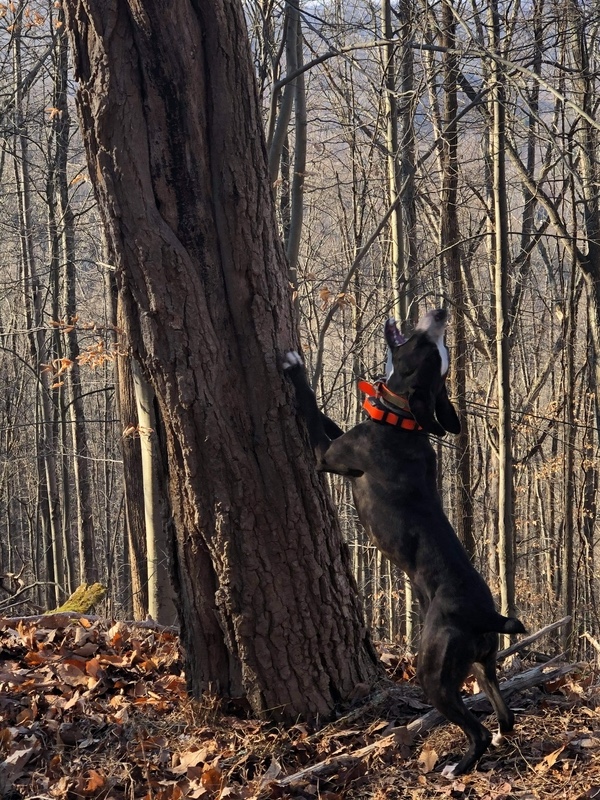
The most defining “particular” trait that separates the Mountain Cur (an AKC FSS breed as of this writing) from its cur cousins is its emphasis on treeing. While many cur breeds developed as broadly multipurpose farm dogs—expected to handle everything from stock work to predator control—the Mountain Cur was refined in the rugged terrain of Appalachia to function as a “vertical” hunter. Its primary task was not simply to find game, but to drive it upward into a tree and hold it there until the hunter arrived.
This contrasts with the working emphasis found in many other cur strains. For example, some cur breeds—particularly those developed for livestock management or hog hunting—are commonly used as bay dogs, locating game on the ground and holding it through sustained pressure and confrontation. The Mountain Cur, by contrast, has been selectively shaped to prioritize treeing behavior and to maintain a steady, committed presence—often described by hunters as “tightness on the tree”—for as long as necessary.
This distinction is not merely a matter of training preference; it is reflected in both build and ancestry. According to the UKC breed standard, the Mountain Cur is a medium-sized, square, or just slightly longer than tall, proportioned athlete: powerful without excess bulk, and agile enough to work relentlessly in steep, timbered country. This compact structure allows Mountain Curs to move efficiently through rocky hillsides and dense hardwood forests where endurance, balance, and quick directional changes matter more than raw mass.
By comparison, some cur breeds are larger and heavier, built for the physical demands of baying hogs or managing cattle in the flatter terrain of the southern lowlands. While individual size varies widely by line, these dogs are often more heavily muscled and suited to sustained ground confrontation. The Mountain Cur trades mass for agility. Some dogs may also exhibit a naturally bobbed, bobbed, or of medium length tail.
This lighter, more agile build supports a hunting style that favors speed and efficiency. Mountain Curs are expected to range actively through cover, and many work with their heads up when conditions allow, catching scent on moving air as well as following ground trails. This adaptability enables them to locate and tree fast-moving quarry such as squirrels or raccoons before the animal can escape into brush piles or rock dens.
Training practices reflect this highly specialized role. To transition a young Mountain Cur from “trash breaking”—discouraging pursuit of unwanted game like deer or rabbits—to focused treeing work, experienced handlers typically begin early, often between six and ten months of age. The goal is to clearly distinguish between undesirable ground chases and the desired outcome of a treed animal. Once a dog is considered “straight,” training emphasis shifts toward reinforcing tightness on the tree: the dog learns that sustained, focused treeing behavior is what ultimately brings the hunter and the reward.
Handlers may accomplish this by dragging scent-saturated lures through the woods and hoisting them into a tree, deliberately delaying their approach until the dog settles into a steady, rhythmic tree bark. The lesson is clear and consistent: persistence at the tree is what completes the hunt.
Another defining difference lies in voice and mental focus. Breed sources consistently note that a Mountain Cur should possess a clear, carrying bark—one that can be heard at distance and that changes in tone or cadence once game is treed. This vocal shift signals to the hunter that the chase has ended and the work has moved overhead.
While some cur-derived breeds became increasingly specialized for trailing and treeing—sometimes described as scent hounds in a cur’s body—the Mountain Cur occupies a distinctive middle ground. It remains grittier and more territorial than many traditional scenthounds, yet more consistently tree-focused than cur strains centered on livestock work. Marked by its pioneer intensity, the Mountain Cur tends to be reserved with strangers, highly loyal to its people, and deeply territorial on its own ground.
If you encounter a cur that shows little interest in what scuttles underfoot and instead works the woods with an eye toward the canopy, chances are good you are seeing a Mountain Cur.
Photo of a Mountain Cur by David DuKate/Dreamstime