Seasoned and well-traveled skiers know the difference between corn snow, powder, packed powder, hardpack, graupel, and dust on crust—as well as our personal favorites (not): crud, concrete, and crust. Snow conditions can mean the difference between a great day of wackeln in a bowl or a visit to an orthopod.
As we write, half the country is expecting a severe Arctic blast, and we are reminded that there are winter terms that are also geographically unique. Fun fact: In Texas, ‘blue northers” are a familiar part of winter bringing sudden, sharp cold fronts that sweep across the Southern Plains with plunging temps and a dose of freezing rain or sleet. These systems probably owe their name to the clear blue skies that often follow such weather. Other parts of Texas may refer to the same brutal blast as a “blue whistler,” while Oklahomans know call it a “blue darter” or “blue blizzard.”
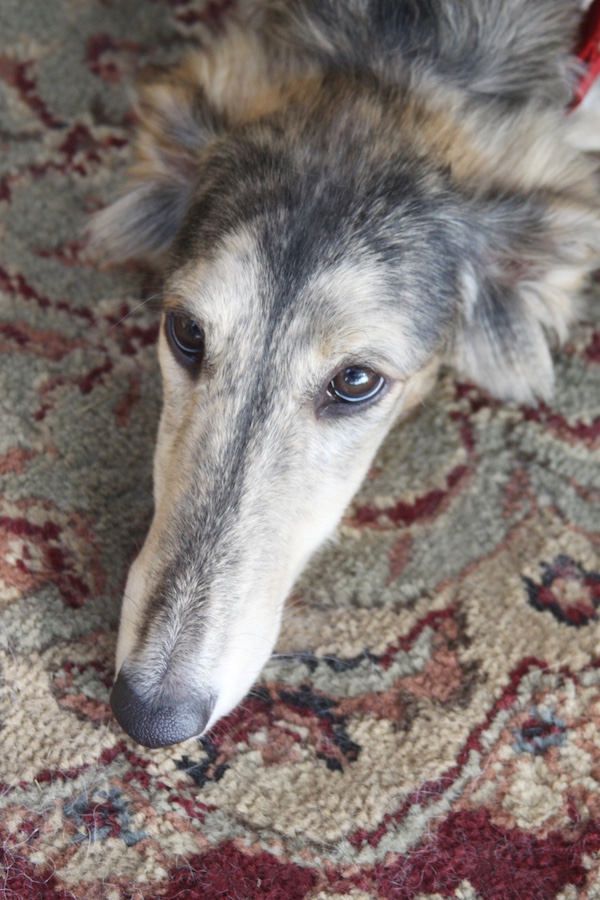
From Texas weather to a Texas dog, we segue to the Silken Windhound (use the search bar on this site to look up ‘Silken Windhound’ and you’ll find more on its history). In this post, we focus on the unusual niche the Silken occupies in the sighthound world as dogs that combine genuine speed and prey drive with a consistently handler‑oriented mindset.
Breeding priorities, written standards, and competitive outcomes all converge on the same point – that this is a sighthound deliberately selected for an unusually responsive, people‑oriented temperament rather than one that tilts towards a more independent nature. The International Silken Windhound Society and United Kennel Club standards describe an intelligent, balanced hound that is affectionate and socially stable, explicitly faulting unwarranted timidity or nervousness and favoring an alert, willing companion rather than a detached or stand‑offish temperament. In real‑world training scenarios, this selection has produced dogs that performance trainers often characterize as a functional “bridge” between high‑drive sighthounds and some more biddable working breeds. Silkens are indeed capable of intense pursuit and athletic effort, but they are notably receptive to shaping, reinforcement, and cooperative work, a combination that is atypical among classical sighthounds.
This temperament profile is reflected in competitive settings that demand versatility rather than specialization. At the UKC Premier, Silken Windhounds appear with regularity among Total Dog qualifiers and winners when considered relative to their small entry numbers. The Total Dog program requires a dog to succeed in the conformation ring and also earn a qualifying score in a performance event such as agility, rally, or obedience on the same day, providing a concrete demonstration that a single individual can meet a structural ideal and immediately transition into functional work. For a numerically small breed, repeated success under these criteria reinforces the conclusion that this balance of type and trainability is unlikely to be incidental.
As always, we defer to breed experts, but our reading suggests that breed and kennel histories from the late 1980s and 1990s consciously cultivated such traits. Early dogs were often described informally as “small Borzoi,” reflecting the visible influence of quality show and coursing Borzoi in the foundation stock. However, the breeding program under Francie Stull quickly emphasized moderation, athleticism, and practical performance. The incorporation of long‑legged Windsprite‑type lurchers and a Whippet from established American lines was aimed not at novelty, but at producing a smaller, coated sighthound with sound movement, endurance, and a workable temperament. Put another way, a sound Silken is expected to be outward‑facing, confident, and mentally available to its handler. Perhaps the best of both worlds.