
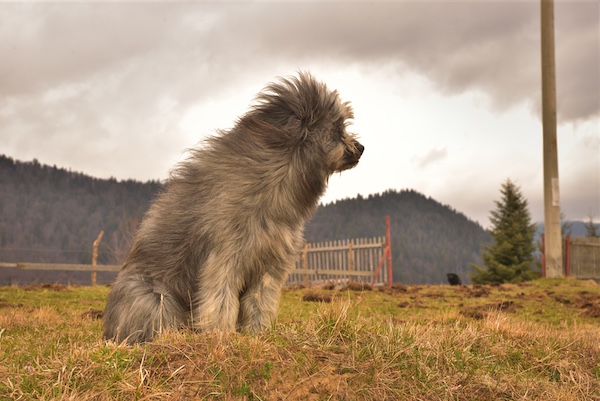
When herders move their sheep, goats, or cattle to cooler mountain pastures in summer and return them to lower valleys in winter, the practice is known as transhumance. This fixed seasonal movement can involve long journeys or shorter ones (called pendulation), and includes not only livestock but also the guardian dogs that protect them. In Romania, transhumance is thousands of years old and has shaped landscapes, rural life, and the selection of working dogs.
Its ecological effects are easy to recognize: the repeated passage of flocks and dogs has created and maintained “grazing mosaics” of meadows, pastures, and ecological corridors. Less obvious is how shepherds have traditionally evaluated dogs themselves. That process is documented by ethnobiologists C. Ivașcu and E. Bíró in their 2020 Journal of Ethnobiology article, which offers a striking example of how folklore and dog lore intersect in Romania.
In “Coexistence through the Ages: The Role of Native Livestock Guardian Dogs and Traditional Ecological Knowledge in Romania,” the authors describe fieldwork in the village of Târsa, where a shepherd explains that puppies may have one, two, or three unusually long, straight hairs beneath the chin. According to local belief, these hairs foretell a dog’s future: pups with one or three are destined to be good livestock guardians, while those with two are not.
The researchers refer to this as the “magic hair” belief—a “peculiar practice for selecting LGDs from pups” that functions as a traditional, pre-work test of character rather than an empirically validated method. The dogs themselves are called “Romanian White Shepherd dogs” (Ciobănesc Românesc Bălan) by shepherds: large, white livestock guardians from the Carpathians. They may overlap with, predate, or exist alongside formally recognized breeds such as the Romanian Mioritic, Carpathian, or Bucovina Shepherd Dogs.
The paper links the hair-count test to a broader Romanian legend that wolves possess three special hairs inherited from the devil, suggesting a regional tradition in which unusual hairs signal temperament, moral character, or supernatural inheritance. While modern breed references do not mention the under-chin hair motif, they do reflect the cultural environment that allows such beliefs to persist. Breed histories from sources such as Wisdom Panel and the UKC emphasize that Romanian livestock guardian dogs are deeply embedded in local legends and folk songs and are viewed as culturally significant protectors of the Carpathians—an ideal setting for folkloric interpretations like the “magic hair” test.
The same research also notes other traditional selection markers, including a preference for white (bălan) or white dogs with black markings (florian) so sheep would not mistake them for wolves, as well as the use of apotropaic red tassels attached to collars to ward off the evil eye.
Taken together, these practices reveal a living pastoral culture in which practical experience, symbolism, and superstition coexist. It is precisely this cultural context that purebred dog advocates risk losing if modern standards are allowed to eclipse the folklore that helped shape these breeds in the first place.
Image: Romanian Mioritic Shepherd Dog by Calinescu Silviu/Dreamstime