It’s a real head scratcher.
“It” is one of those paradoxes that can confound someone not in the dog world – that the word “invisible” should appear in an AKC breed standard when by its very definition, a standard explains how an ideal dog of its breed is supposed to look.
To explain, the exact language to which we’re referring reads, “Coat: Smooth-haired, short, hard, thick and close lying. Invisible gray undercoat on neck permissible”
Wait, what? If it’s invisible, how do you see it?
Traditionally, writers of breed standards tend to use everyday words, but often in a very narrow, insider way; “invisible” in the Doberman Pinscher’s AKC standard is one of those places where plain English and practical judging language collide.
In normal English, invisible means “cannot be seen at all,” but in Doberman-breed-standard-speak, it functionally means “present, but not apparent unless you go looking for it.
Let’s put it in human terms. Jack is going to a black tie event, and he has rented a fabulous black tuxedo (think James “007” Bond). Underneath it, however, he’s wearing his favorite undershirt. Read: It’s frayed, ratty, and worn out in spots. It’s “invisible” to the crowd, but if a flirty someone insists on fixing his crooked bow tie and accidentally sees what’s underneath, the t-shirt is no longer invisible.
That’s what “invisible gray undercoat” is getting at in the Doberman standard. The gray is there, but under normal “party conditions” – i.e., the dog standing in the ring with coat lying flat, viewed at arm’s length – no one should see it. It only becomes evident if the coat is parted or examined closely, and that is what the standard is saying: it’s “invisible” until someone goes looking for it. Gray hair should not peek through the Doberman’s short, sleek topcoat. If one can see gray patches while the dog is just standing there, it ruins the clean, solid look of the “black and tan” (or red, blue, or fawn) coat.
So if it’s supposed to be invisible, why not just say “no undercoat allowed”?
Because dogs are not cookie-cutter creatures. The AKC included this phrasing to be permissive. It acknowledges that because of the breed’s genetics, a little bit of gray undercoat on the neck is a natural occurrence, and by calling it “permissible,” they are telling judges: “If you find some gray fuzz hidden deep under the coat on the neck, don’t penalize the dog. It’s fine as long as it doesn’t ruin the overall silhouette.
And the Doberman Pinscher is not alone in having this word in its standard. The German Wirehaired Pointer standard reads, “The undercoat is dense enough in winter to insulate against the cold but is so thin in summer as to be almost invisible.
It is this linguistic tension (describing how a dog should look, while allowing something that, by definition, we “shouldn’t see”) is exactly why the word jumps out as a head-scratcher to anyone who reads standards literally instead of “fluently.”
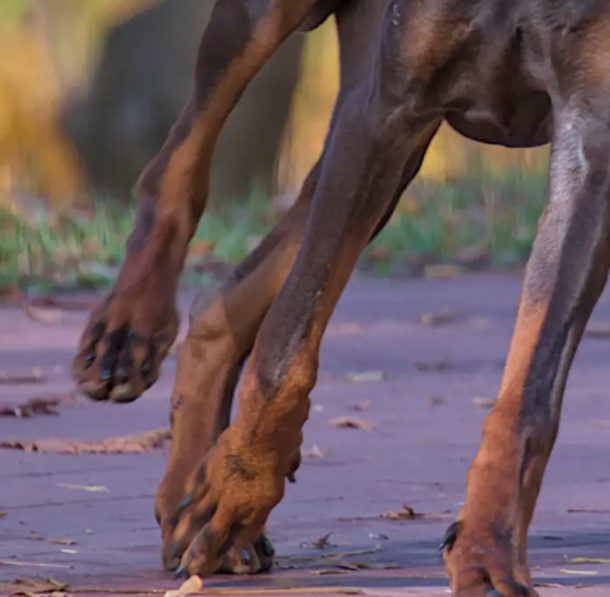
Image: Doberman Pinscher by SERHII LUZHEVSKYI/iStock