
Day and night for forty-four years, Florence Martus waved at ships entering and leaving the Port of Savannah, Georgia. Between 1887 and 1931, she stood at a vantage point on Elba Island in the Savannah River waving hello and goodbye to sailors. For most of those years, one of her Collies was at her side.
Locals will tell you that Florence’s story began with a young girl’s promise to a sailor. According to local lore, she fell in love with a man at sea and vowed to be the first person to greet him upon his return; though he never came back, she spent the next four decades faithfully waving at every ship, just in case he was aboard. The truth is less poetic, but no less remarkable: For all those years, Florence waved not for a single lost love, but out of habit, solitude, and an enduring affection for the seamen who came to recognize her as a constant presence on the Savannah River. Florence never married, and some say her lifelong singleness helped fuel the romantic legend surrounding her; historians, however, generally agree that her unmarried status reflects a life marked by independence, loneliness, routine, and quiet devotion to her dogs, and not a lost romance.
Florence’s story actually began earlier when her brother, George, took over lighthouse duties on Elba Island. She joined him as housekeeper and companion, trading city life for the isolated rhythm of river traffic and tides. She began to stand on the edge of the river and wave a handkerchief or a towel during the daytime (a lantern at night) and when ship captains spotted her, they sounded their horn three times. Some have estimated that Florence waved as some 50,000 vessels over 44 years, and she stopped only when she was forced to do so when her brother, then 70, had to leave his lighthouse job and the home that went with it.
Why did she do it?
Florence herself said it was simply because she was lonely. There she was, a young girl living on an isolated island, with nothing to do but stare at the water, and wait for ships to pass. Her cheerful efforts established her as an steadfast part of local maritime history. She came to be known as “The Waving Girl” of Savannah, always a Collie by her side. Local history has it that she and George bred their Collies, though there are no records of pedigrees, registration, or formal breeding lines from any kennel or breed registry that we could find. All we know is that early on, the dog by her side was named, “Rex.” Presumably, it is this dog that was immortalized in bronze when the city decided to erect a monument honoring Savannah’s Waving Girl.The process of getting funds to do it took several years, but in 1968, enough money was available to finance the project. The initial plan was to place the statue in Washington Square, part of Savannah’s Historic District, but the community concluded that a better location would be Morrell Park on East River Street, overlooking the waterfront.
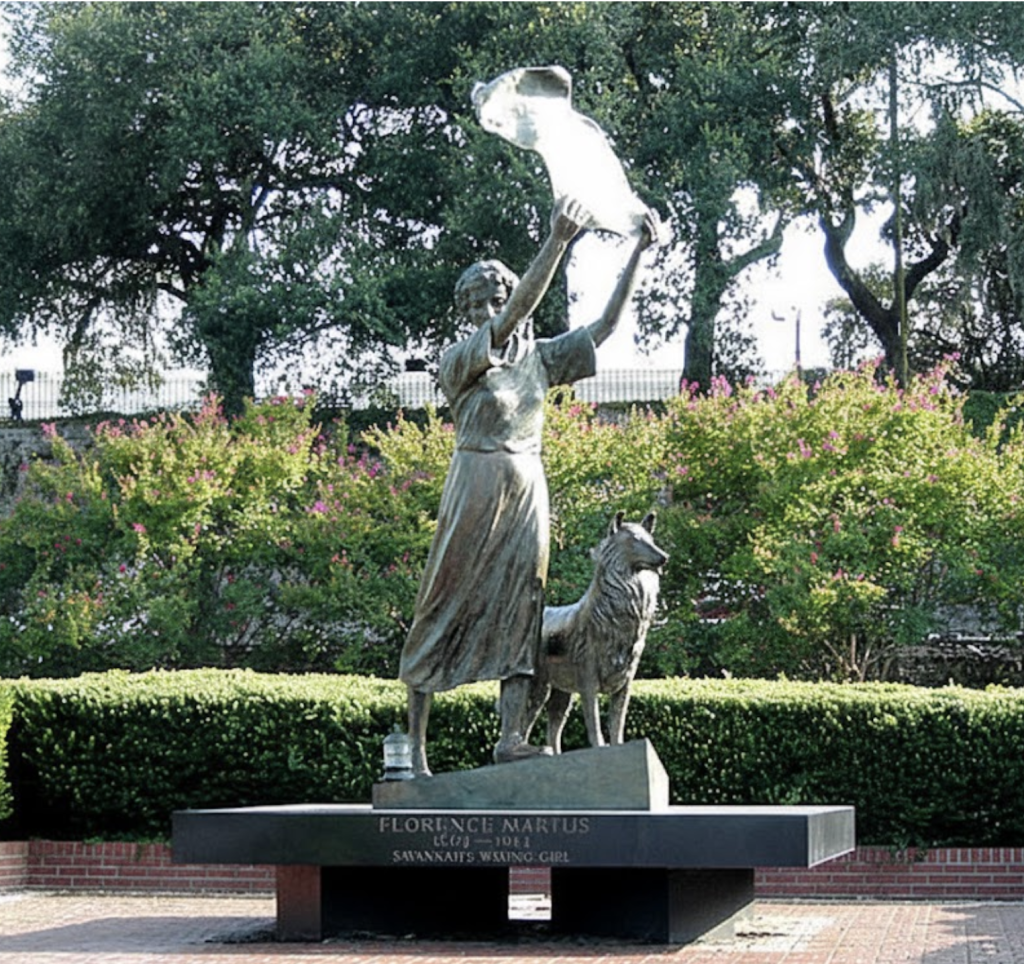
Photo by Marque1313 Public domain/wikicommon
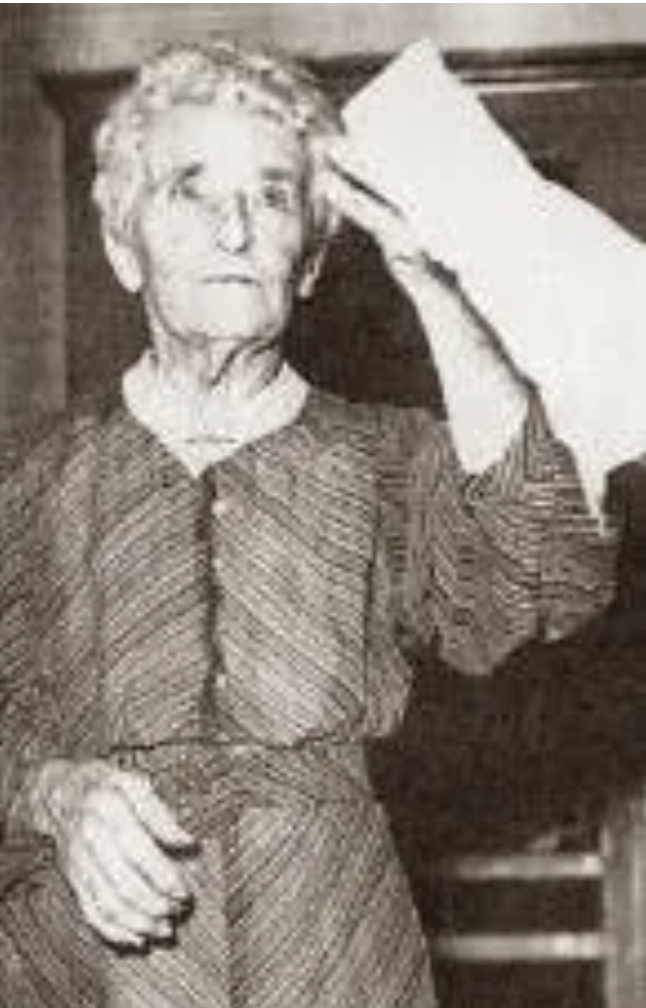
Photo of Florence in later years
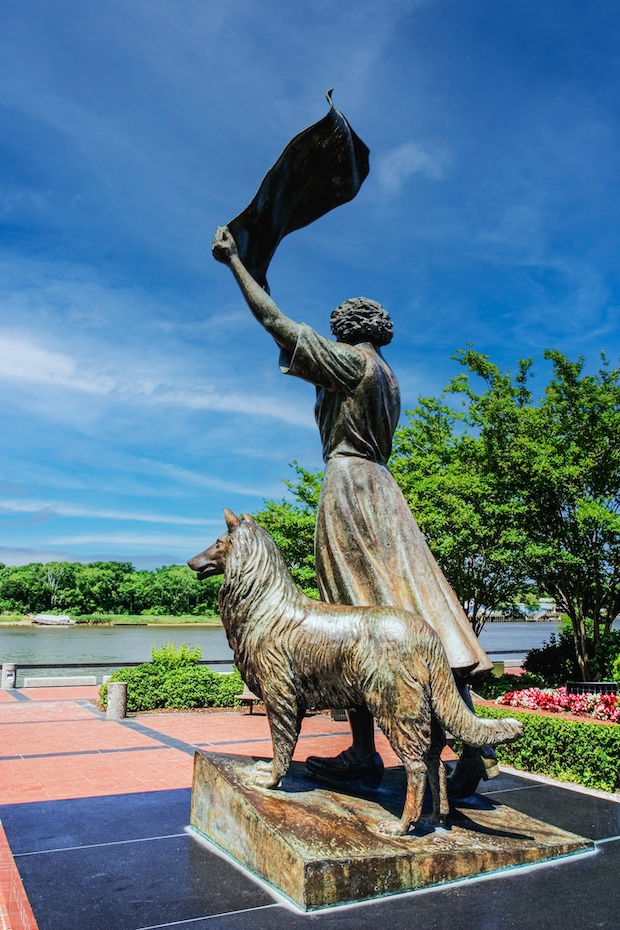
The distinguished sculptor, Felix de Weldon, was chosen to design the monument (he also created the Marine Corps War Memorial in Virginia) and he based his composition on feedback he got from locals who wanted the monument to capture Florence’s essence. The 9-foot tall bronze depicts young Florence in a simple short-sleeved dress, both hands holding a flowing handkerchief. At her feet is the lantern she used at night, and by her side, a Rough Collie.
The Waving Girl Statue was cast in Rome, Italy, and dedicated in 1972, a year after it arrived in Savannah. It’s said that the ship’s captain who brought the statue refused payment because of the fond memories he had of Florence. To this day, some ships blow their horn to salute the monument when entering the Savannah River.
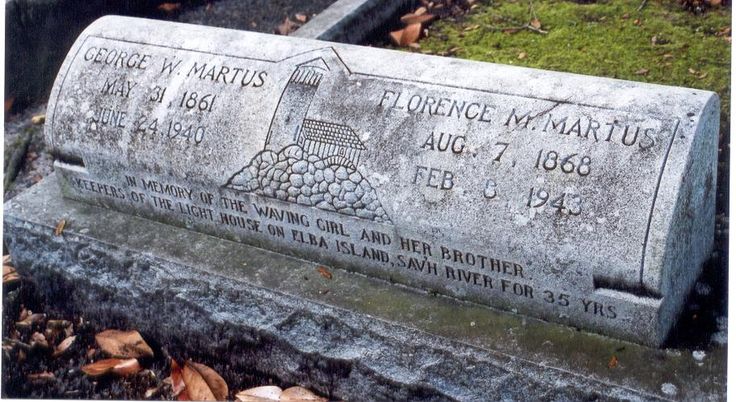
Three years after George died, Florence Martus joined him on February 8th, 1943. The siblings were buried side-by-side in the northern portion of Laurel Grove Cemetery. Their headstone reads: “In memory of the waving girl and her brother. Keepers of the lighthouse on Elba Island, Savannah River for 35 years.”
Florence’s story doesn’t end there. After her passing, the Propeller Club of Savannah named a Liberty ship after her. The SS Florence Martus was revealed in 1943 with a massive celebration on Cockspur Island. According to the Georgia Historical Society, the SS Florence Martus was the 30th out of 88 Liberty ships built in Savannah. Throughout the years, these historic vessels have been scrapped, and only a handful remain today.
Top photo by Dndavis/Dreamstime