

Its origins are rooted in a vivid legend that has endured within family – and breed – tradition. In 1415, during the Battle of Agincourt—one of the most celebrated English victories of the Hundred Years’ War—Sir Piers Legh (also recorded as Peers or Peter) was gravely wounded on the battlefield. According to longstanding Legh accounts, his devoted Mastiff bitch stood guard over him for hours amid the carnage, protecting her master until he could be rescued. Returned to Lyme Hall, she whelped a litter that became the foundation of the Lyme Hall Mastiffs. This act of loyalty is commemorated in an old stained glass window still preserved in the drawing room of Lyme Hall, depicting Sir Piers alongside his faithful bitch—a tangible and evocative link to the strain’s beginnings. We have yet to find an image of that particular pane of glass.
These dogs were formidable guardians: massive in scale, with “cinderblock-broad” heads, powerful muscular frames, short coats often with the classic black mask, and a temperament that merged immense strength with profound fidelity. Bred in near-isolation by the Leghs, the Lyme Mastiffs served as estate protectors and emblems of noble authority, celebrated for their purity and working qualities. For generations they were regarded as among the most authentic and superior representatives of the Mastiff type in Britain.
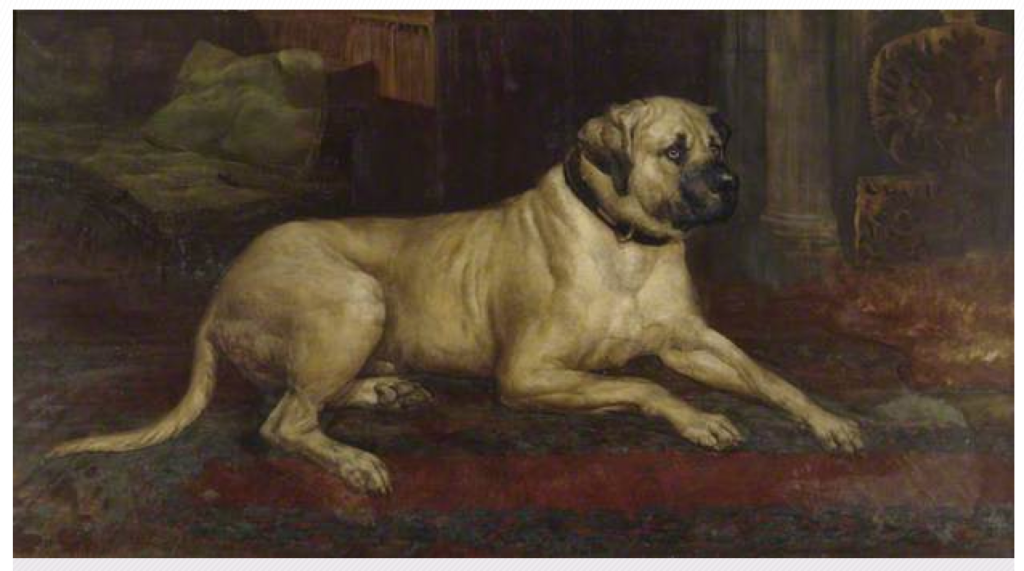
Image of “Lion,” one of the last of the Lyme Hall Mastiffs, painted by J.T.Nettleship (1847-1902) still hangs in the entrance hall at Lyme Park, Cheshire. See it on the wall at this link: https://www.greatbritishlife.co.uk/resources/images/17737910.jpg?type=mds-article-620

By the late 19th century, however, the strain had suffered a marked decline. Observers of the time described the remaining dogs as inferior in conformation and vigor—far removed from the glory of their predecessors.
The line’s final chapter came during the horrors of World War I: around 1917, food shortages compelled the family to euthanize the last of the pure Lyme Hall Mastiffs. We can’t even image it.
Though the distinct bloodline is now extinct, its genetic legacy persists, having contributed foundational stock to many modern English Mastiff pedigrees during the breed’s late-19th-century revival.
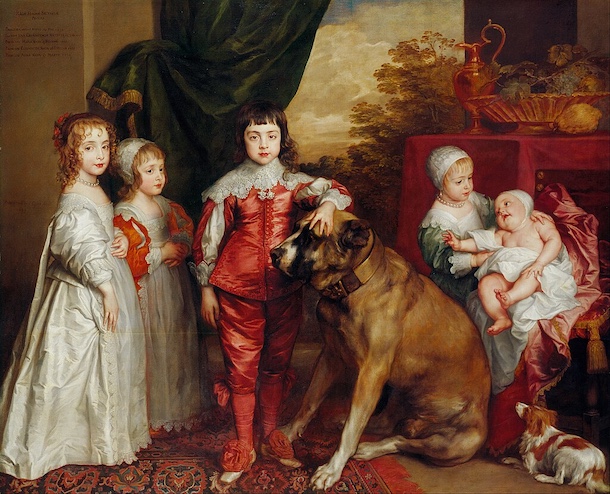
The Lyme Mastiff’s legend extends beyond kennel histories into the realm of fine art. In 1637, Flemish master Sir Anthony van Dyck captured the breed’s regal essence in his masterpiece The Five Eldest Children of Charles I (Royal Collection Trust). The portrait depicts the royal siblings—Mary, James (future James II), Charles (future Charles II), Elizabeth, and infant Anne—in a composition of tender yet stately dignity. At the center stands young Prince Charles, his hand resting confidently on the head of a formidable Lyme Mastiff. The dog’s imposing presence and calm authority dominate the foreground, serving as a potent symbol of protection, loyalty, and sovereign power amid the gathering political storms that would soon lead to the English Civil War.
A smaller King Charles Spaniel appears at the composition’s edge, offering a charming contrast in size and temperament, yet in our view, it is the Mastiff that commands attention—its deep chest, broad haunches, and watchful gaze evoking the protective qualities of the Lyme Hall strain. Van Dyck, who frequently incorporated dogs to underscore character and status in his portraits, elevated the Lyme Mastiff to an enduring icon of Stuart-era nobility. Indeed, Grande Dame of the Mastiff world, Betty Baxter, once opined that the Lyme Hall Mastiffs did indeed look very much like the dog in Van Dyck’s painting (at the top).
Sadly, no pure representatives of the Lyme line survive today, but their influence endures in the noble bearing of the modern English Mastiff, as well in art that reach us from across centuries, and in the quiet presence of that stained glass window at Lyme Hall, where a knight and his faithful guardian remain forever linked in glass and memory.
Mastiff affectionados will want to read Amy Fernandez’s piece in Modern Molosser here.
Top image: The Five Eldest Children of Charles I by Sir Anthony van Dyck