The first time we did it, someone nearby muttered, ‘If you’re going to get this intimate, shouldn’t you buy him dinner first?’ By the umpteenth time, the consensus was simpler: ‘If you’re groping a stranger’s inner thigh, you’re clearly evaluating a dog.”
And they were right. Getting hands‑on with a dog’s ‘hammies’ is especially common when assessing a breed that makes its living on the move; a fine example of such a breed is the Bouvier des Flandres whose AKC breed standard even states, “Firm, well muscled with large, powerful hams,” and “thighs wide and muscular.”
To be clear, ‘hams’ refer specifically to the muscular rear portion of the Bouvier’s upper thigh muscles that include the major muscle groups, the biceps femoris, semitendinosus and semimembranosus. These form the broad, heavy mass one should feel behind the pelvis (often called the “second thigh” or “rear assembly power unit”) of an adult dog. The term is borrowed from livestock terminology (like a ham cut of pork).
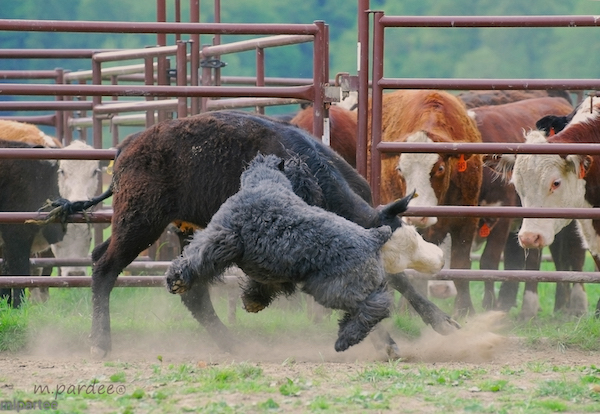
Unlike wide-running breeds, a Bouvier often works in tight quarters (stockyards or narrow lanes). To turn, say, a 1,200-pound steer, the dog must be able to pivot its entire body weight on a dime. The gracilis and adductor muscles on the inner thigh provide the lateral stability to “anchor” the hindquarters during these high-torque maneuvers. They may also use their bodies to “bump” or push stubborn cattle which requires immense rear-end drive. If the inner thigh is flabby, the dog loses the “locking” mechanism in the hocks, and their shove becomes a stumble. Remember now that a cow’s primary defense is a side or rear kick. A Bouvier must be able to spring sideways or backwards instantly to avoid a hoof. The “sideways explosion” is powered almost entirely by the muscles on the inside of the leg.
And if the dog isn’t working stock?
It matters not if the dog is carting, performing in an agility ring (or herding), a fit inner thigh muscle is the “stabilizer bar.” Some might even say that the inner thigh is the diagnostic center for a Bouvier’s fitness. Whether a judge is evaluating it in a show ring, or a breeder is assessing a potential sire or dam, the technique is much the same: One runs their hands over the dog’s rear assembly, slides their hand along the outer thigh, and then the inside thigh (adductors). They are feeling for density (not softness), symmetry, and fill toward groin.
Balanced inner and outer thigh muscling correlates with legs that track in a straight, stable line under the body rather than “rolling,” weaving, or crossing over, but there is no substitute for a hands-on check. Some dogs can appear well muscled from a distance, while others might have been groomed to suggest muscling under a tousled, double coat trimmed to accent certain lines. Once one has felt a Bouvier with a well muscled thigh, there is no “unfeeling” it. The thighs of a correct Bouvier should feel solid, packed, muscled, and not hollow between legs. Historically, a fit Bouvier bulldozed its way with authority, and a “meaty” inner/back thigh isn’t just for show—it’s the engine that that powers every shove, stop, and sideways burst.