
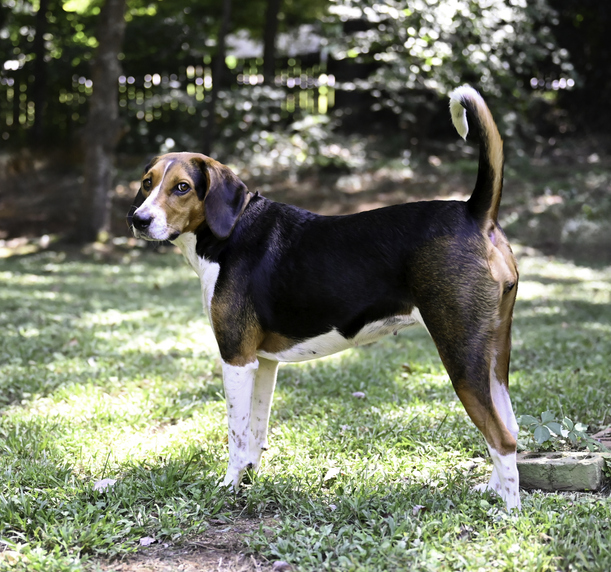
You won’t find the term in official AKC or UKC terminology, but it’s a colloquial label used by hunters and houndsmen: dark hounds with a black back or saddle and rich tan legs are often called “high tans” or “hi-tans.” The phrase is most often associated with darker Treeing Walker–type and related hunting hounds whose markings depart from the familiar white-bodied Walker pattern seen in the show ring and breed literature. Instead of broad white areas broken by black spots and tan trim, a high-tan hound may appear almost entirely dark at first glance, with rich tan legs, cheeks, and eyebrows beneath a sweeping black “blanket” or saddle covering the back and sides. Some hunters also refer to hi-tans as “saddleback” or “blanket-back” Walkers, and in a few circles one even encounters the phrase “American Saddleback Hound,” though none of these are official breed names.
To understand why the term arose, it helps to remember that coonhound culture has long existed in a world somewhat apart from kennel-club formalities. Hunters historically bred for nose, stamina, voice, tracking ability, tree instinct, and grit—not cosmetic consistency. A dog that could move a cold track on a frosty night and stay treed until dawn earned admiration regardless of whether it matched a preferred color pattern. In many hunting communities, nicknames and descriptive shorthand naturally developed to identify certain strains, looks, or family lines of dogs, and “high tan” appears to be one of those practical, visual terms.
The coloration itself likely reflects the mixed hunting ancestry behind American coonhounds. Early foxhounds and regional running hounds were blended over generations before modern registries standardized breeds, and those shared roots may help explain why dark saddleback coloration still occasionally appears in Treeing Walker lines even though extensive white became the more characteristic pattern in the modern breed. The look can give high tans a distinctly old-fashioned appearance: some resemble the heavier saddleback foxhounds seen in nineteenth-century sporting art, while others echo the darker outlines of Black and Tan Coonhounds or certain European scenthounds. For hunters familiar with the vocabulary, the sight of a mostly dark Walker-type hound with tan points is enough for the quiet verdict: that’s a high tan.
Today, the phrase survives mostly through oral tradition, conversations at hunts, and scattered references on message boards and social media rather than in formal breed literature. It remains a small but colorful reminder that the language of working dogs is often every bit as rich, layered, and regionally distinct as the dogs themselves.
A word about our image. While it is listed as a Treeing Walker Coonhound — allegedly — it would fare poorly in a show ring, and we share the photo taken by Alison Rose soley to show the coloring of a dark, saddleback with a broad black blanket, rich tan head and thighs, and reduced white on the body—essentially the look hunters often call a “high tan.” It is surprisingly difficult to find the perfect photo, and if a reader has a better photo and are willing to let us use it instead (full attribution, of course), reach out to us!