
Italy has gifted the dog world a remarkable lineage of native working breeds, and among the most deeply rooted in its rural culture is the Segugio Italiano. This medium‑sized scenthound is a specialized athlete, built to track hare and wild boar over steep, rocky terrain for hours at a time. In English‑speaking circles, some enthusiasts use the shorthand “Segit,” while the dedicated Italian hunters who work these hounds are known as Segugisti—a title reflecting a tradition centered on field function rather than the show ring.
The origins of the Segugio Italiano are ancient enough to blur the line between archaeology and legend. While theories differ, most historians and canine authorities agree that the breed belongs to an old Mediterranean scenthound tradition refined over centuries on Italian soil. One longstanding theory links its ancestry to early hunting dogs of the eastern Mediterranean and North Africa—primitive Egyptian‑type hounds that may have entered the Italian peninsula through Phoenician and later Roman trade routes. Over generations, these dogs were likely blended with local hunting hounds selected for the rugged terrain and quarry of the peninsula.
Classical art and later Renaissance works frequently depict lean, drop‑eared scenthounds with the long head, refined frame, and slightly convex profile associated with the modern Segugio, suggesting remarkable continuity of type across centuries. Italian breed historians have often pointed to hunting‑dog figures in Roman sculpture and museum collections as evidence of the antiquity of this hound style, though such comparisons remain interpretive rather than definitive proof.
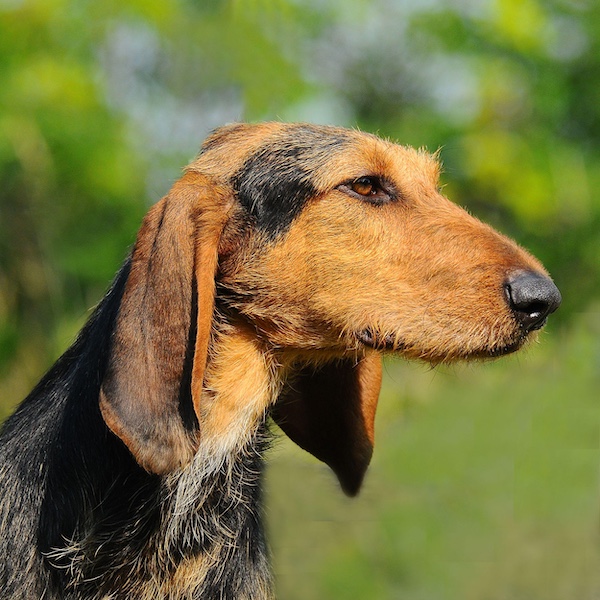
In the modern era, Italian cynologists and the Fédération Cynologique Internationale recognize two coat varieties within the Segugio Italiano tradition: the Smooth‑haired (Pelo Raso) and the Rough‑haired (Pelo Forte). Both share the same essential structure and hunting style, differing primarily in coat texture. The Smooth‑haired variety carries a short, dense, close‑lying coat well suited to warmer climates and more open country. The Rough‑haired variety possesses a harsher, more weather‑resistant coat that offers greater protection against thorny undergrowth and dense cover. Hunters sometimes speak of subtle temperament differences between the two, though formal descriptions emphasize that both are prized for endurance, concentration, and determination on the trail. Shared by both varieties are the breed’s characteristic “hare feet”—tight, oval paws that provide secure footing across uneven, often stony ground.
What truly distinguishes the Segugio Italiano is the importance placed on voice. Experienced Segugisti do not merely listen for barking; they interpret changes in rhythm, tone, pitch, and intensity to understand the progress of the hunt. Traditional Italian hound culture places enormous value on a clear, musical cry carried over distance, allowing hunters to follow both the direction and excitement of the chase through difficult country
Physically, the Segugio is a study in functional efficiency: lean, muscular, deep‑chested, and built for stamina rather than brute force. Its dry, sculpted head, long ears, and powerful yet economical movement reflect generations of practical selection by hunters rather than fashion breeding. Although energetic and intensely driven in the field, the breed is widely regarded as affectionate and deeply bonded to its people at home—a natural result of centuries spent living and working closely alongside hunters.
Today, while regional Italian scenthounds such as the Segugio Maremmano have gained popularity for specialized wild‑boar work, the Segugio Italiano remains one of Italy’s defining native hounds. More than a hunting dog, it is a living expression of Italy’s rural sporting culture—maintained by generations of Segugisti who continue to value stamina, intelligence, nose, and the unmistakable music of the chase.
Close up image of a Rough-coated Segugio Italiano by WireStock/Alamy