Color with Speed!
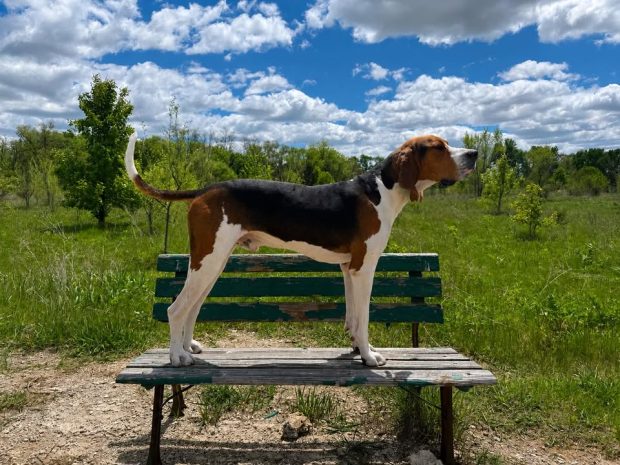
The Treeing Walker Coonhound is historically and functionally a tri‑colored hound. Both the AKC and UKC breed standards explicitly state that tri‑colored—white, black, and tan—is preferred, with bi‑colors (white with black or white with tan) also permitted but less typical. Bred to run hard and stay on a track, the Treeing Walker combines this striking tri‑color coat with a racy, athletic outline and effortless, ground‑covering gait that speaks to its speed and endurance.
Did you know that this strong emphasis on tri‑coloring reaches back to the time when Walkers were still registered under the broader English Fox and Coonhound umbrella?
As the various coonhound strains separated, both color and hunting style helped distinguish them. The American English Coonhound became strongly associated with ticking and roan‑type patterns, while Treeing Walkers came to be known for those clear tri‑color coats, with black, white, and tan (or white, black, and tan) as the expected patterns and white‑and‑black bi‑colors seen less frequently.
People who hunt with these dogs will tell you that the Walker’s speed isn’t an accident. Early breeders set out to “speed up” their old foxhound packs so they could keep steady pressure on quicker foxes and rangy raccoons, and that legacy shows in a hound that can fly over rough country for hours. In modern night hunts, that same blend of speed and quick decision‑making has helped make the Treeing Walker the people’s choice in the competition woods, where getting to the track first and staying on it can make all the difference.
Genetically, the classic Treeing Walker coat is essentially a black‑and‑tan pattern expressed over a white “pack hound” base. That look comes from the interaction of spotting genes that add white to the coat with the tan‑point pattern familiar in many hounds and working breeds. The same genetic framework can also produce acceptable bi‑color Walkers—white with black or white with tan—when the distribution or intensity of pigment shifts, but for generations breeders have favored a clearly defined black saddle or blanket with rich tan points on a bright white background.
Because heavy ticking is so closely associated with the American English Coonhound, Walker breeders have traditionally selected away from the modifiers that produce it. Over time this has reinforced both a visual and genetic divide between the two breeds: the American English as the “ticked” hound, and the Treeing Walker as the clean‑coated tri. In a Walker, breeders and judges tend to value a deep, rich tan, a lustrous black blanket or saddle, bright, unticked white, and minimal to no ticking, which is considered undesirable on a Treeing Walker even though it is a hallmark of the American English.
We invite you to take a longer look at the dog in this photo. What we see, balanced on a worn bench under a big sky, is a beautiful hound coiled like a spring, full of stored energy and ready to burst into motion. You get the sense that if you whispered “hunt ’em up” into a velvety ear, this elegant outline would turn into a blur of tri‑color motion, and you’d be watching nothing but that white tail tip flagging as it disappears into the green.
Our thanks to Harris Hannah for granting us permission to use the photo of her Treeing Walker Coonhound, Skylines Dang It Bobby.