
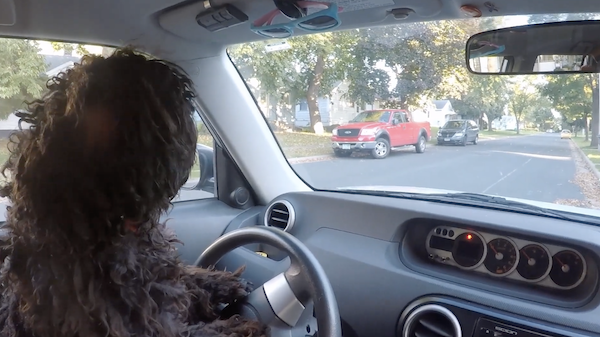
The quality of the Puli had a lot to be desired.
Wait, no, not the dog breed!
The Puli in this story is the Hódgép Puli, a tiny Hungarian microcar whose history reads less like a conventional model launch and more like an improvised effort at economic survival against the backdrop of shifting global politics. The first prototypes in the mid-1980s carried the name “Hungi;” later the car appeared in early references as “Pouli” before the spelling settled as “Puli,” a progression that suggests a conscious renaming over time rather than a one-off label.
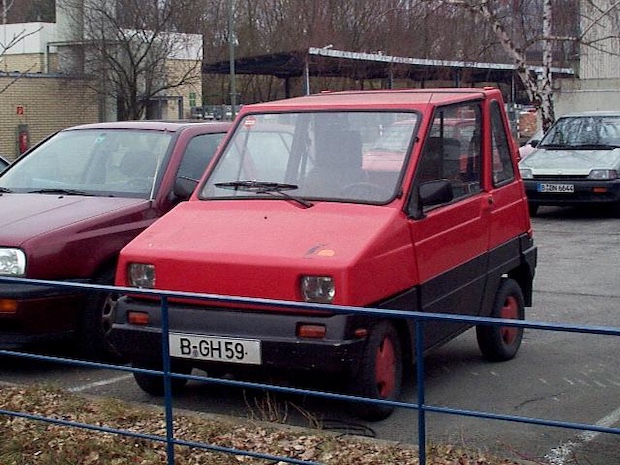
Created in the 1980s at the Hódgép Company of Hódmezővásárhely—whose usual business was building and repairing heavy agricultural machinery—the car emerged during a period of severe hard-currency pressure in Hungary. The socialist government was encouraging domestic manufacturers to develop products that could potentially be exported to Western markets and generate badly needed foreign currency.
Through a chain of intermediaries that feels improbable in hindsight, a Swiss truck dealer of Hungarian origin, the foreign trade agency Technoimpex, and French automotive entrepreneur Teddy Marson all converged on Hódgép with the idea of a new urban microcar. By 1987, the first fiberglass-bodied prototypes appeared under the name “Hungi,” with bodies produced by the Balatonfüred Shipyard rather than a traditional automotive supplier. It was a textbook case of late-Cold War improvisation, where firms experienced in fiberglass and composite work could suddenly find themselves involved in automobile production.
The production car, soon called Puli (or “Pouli” in early mentions), became a compact demonstration of Eastern Bloc parts-bin engineering. To assemble a 2.46-meter city car on limited resources, Hódgép drew on components it could source from across the Eastern Bloc. Instrument panels and assorted fittings were reportedly sourced from Škoda, Lada, and the Polski Fiat 126p. The original 273 cm³ Yanmar diesel engine proved troublesome and was later replaced by a more refined Lombardini unit, while the reinforced fiberglass bodywork was supplied by Imag in Mór, a company associated with industrial composite manufacturing and Ikarus supply work.
On the technical side, this represented a notable exercise in resourcefulness. On the commercial side, it quickly turned into a series of problems. Early on, the company contacted a Western distributor associated with Lada imports, but he reportedly felt the quality of the Puli left a great deal to be desired. Given the car’s mixed sourcing and modest finish, it was apparently not enough to convince him to take it on.
Other Western partners also proved problematic. French importer Jean Hardy reportedly placed a substantial order but repeatedly failed to pay, citing quality and other issues as justification. Another potential partner, Swiss businessman Bruno Fridez, pushed for an electric version of the Puli. On paper, these relationships suggested a path into Western microcar markets, but in practice they weakened the project’s already fragile financial position.
Political change then added to the pressure. With the collapse of the Soviet sphere and the end of the socialist system, Hódgép underwent privatization. In 1991, a new company, Puli Vehicle and Machinery Manufacturing Ltd., was established, and manager Sándor Pikali took charge of the vehicle division. Recognizing that the small diesel microcar segment was limited, he ended cooperation with unreliable Western intermediaries and redirected the project toward electric vehicles.
Under Pikali’s direction, the firm developed a more modern electric model, the Puli 107E (later Puli 2E), along with an electric version known as the Puli Pinguin 4. His plans extended beyond a single model: proposals included Puli-based convertibles, vans, and delivery vehicles/trucks. Despite operating amid bankruptcy proceedings tied in part to the company’s inherited valuation structure—including a reported 340-million-forint asset valuation—the firm continued building vehicles, and electric models were produced during the first half of the 1990s.
The project ultimately collapsed for financial, not technical, reasons. Mounting pressure from creditors led to a forced liquidation, and the company was formally dissolved in 1996. Before that point, however, Pikali later claimed that approximately 2,000 diesel-powered and 6,000 electric-powered Pulis had been produced, though exact production figures remain difficult to verify. For a vehicle developed by a tractor and machinery factory operating under intense economic and political pressure, the Puli must surely stand out as an early example of an urban electric microcar that appeared well before small city EVs became mainstream.
Today, surviving examples are collector curiosities – and cherished finds for micro-car gear heads. The whole saga reflects a transition period in Eastern Europe often marked by optimism, improvisation, and eventual liquidation. The Hódgép Puli remains a fascinating footnote in automotive history: uncommon, tough, and unmistakably Hungarian, sharing its name with the equally distinctive Hungarian herding dog.
As for our image, it comes from a video uploaded six years ago by @ThePuliDog to YouTube. Check it out: