
Some stories sit perfectly between what we can prove and what we love to believe, and every so often history offers one that feels tailor‑made for a breed; long before Irish Terriers were a recognized breed, a little terrier on an English mountain left a legacy that still speaks to us today, and the tale behind Wordsworth’s ‘Fidelity’ is one of them
Fidelity by William Wordsworth
A barking sound the Shepherd hears,
A cry as of a dog or fox;
He halts–and searches with his eyes
Among the scattered rocks:
And now at distance can discern
A stirring in a brake of fern;
And instantly a dog is seen,
Glancing through that covert green.
The Dog is not of mountain breed;
Its motions, too, are wild and shy;
With something, as the Shepherd thinks,
Unusual in its cry:
Nor is there any one in sight
All round, in hollow or on height;
Nor shout, nor whistle strikes his ear;
What is the creature doing here?
It was a cove, a huge recess,
That keeps, till June, December’s snow;
A lofty precipice in front,
A silent tarn below!
Far in the bosom of Helvellyn,
Remote from public road or dwelling,
Pathway, or cultivated land;
From trace of human foot or hand.
There sometimes doth a leaping fish
Send through the tarn a lonely cheer;
The crags repeat the raven’s croak,
In symphony austere;
Thither the rainbow comes–the cloud–
And mists that spread the flying shroud;
And sunbeams; and the sounding blast,
That, if it could, would hurry past;
But that enormous barrier holds it fast.
Not free from boding thoughts, a while
The Shepherd stood; then makes his way
O’er rocks and stones, following the Dog
As quickly as he may;
Nor far had gone before he found
A human skeleton on the ground;
The appalled Discoverer with a sigh
Looks round, to learn the history.
From those abrupt and perilous rocks
The Man had fallen, that place of fear!
At length upon the Shepherd’s mind
It breaks, and all is clear:
He instantly recalled the name,
And who he was, and whence he came;
Remembered, too, the very day
On which the Traveller passed this way.
But hear a wonder, for whose sake
This lamentable tale I tell!
A lasting monument of words
This wonder merits well.
The Dog, which still was hovering nigh,
Repeating the same timid cry,
This Dog, had been through three months’ space
A dweller in that savage place.
Yes, proof was plain that, since the day
When this ill-fated Traveller died,
The Dog had watched about the spot,
Or by his master’s side:
How nourished here through such long time
He knows, who gave that love sublime;
And gave that strength of feeling, great
Above all human estimate!
William Wordsworth’s “Fidelity” sits at an interesting crossroads between documented history and cherished Irish Terrier lore. In April 1805, a young artist named Charles Gough set out to cross Helvellyn in England’s Lake District and never returned. Months later, a shepherd discovered Gough’s body on the mountain, and with him a small, faithful terrier who had remained by her master’s side through the long weeks since his fall. Witnesses later recounted that the dog—often called Foxie or Foxey in retellings (possibly because of her coloring) —had kept her lonely vigil so long that she had even whelped a puppy there on the mountain; the pup did not survive, but the mother stayed. News of the scene spread quickly through the Lakes, and the image of a little dog guarding her dead master gripped the Romantic imagination.
Among those moved by the story was William Wordsworth, already deeply attuned to themes of nature, loyalty, and the bond between people and their dogs. He transformed the Helvellyn tragedy into the 1807 poem “Fidelity,” a meditation on constancy under the harshest conditions, with the dog’s vigil as its emotional core. His verses are not abstract sentiment; they clearly respond to a real event, a real dog, and a very specific landscape he knew well. In doing so, he helped fix in literature the archetype of the brave little terrier whose loyalty outlasts even death.
The tangle begins when we ask what, exactly, Foxie was. Modern Irish Terrier enthusiasts, club histories, and assorted dog‑world references have identified her as an Irish Terrier, and the story has passed along from one generation of fanciers to the next as fact. In those accounts she is not just any terrier, but an Irish Terrier bitch whose steadfast watch on Helvellyn becomes an early, shining example of the breed’s courage and devotion. For a community that treasures stories of “little red dogs” standing firm against long odds, the appeal is obvious.
When we move back toward the early 19th‑century record, however, the picture becomes less sharp. Contemporary mentions tend to describe the dog only as a “terrier” or “bitch terrier,” without further clarification, leaving room for more than one plausible interpretation. Given the kinds of terriers known at the time, it is not unreasonable to imagine that she could have been an early Irish‑type or Irish‑associated terrier, even though “Irish Terrier” as a fully formalized, capital‑letter breed name would come later. We don’t really know.
Even with those historical caveats, Irish Terrier people have long seen a kindred spirit in Foxie, and it is easy to understand why. Her unwavering watch in a harsh mountain landscape mirrors the qualities fanciers prize: hardiness, courage, and a stubborn, cheerful loyalty that does not yield even when circumstances turn bleak. In the broader cultural record, Foxie’s vigil did more than inspire Wordsworth. Walter Scott took up the tale in his poem “Helvellyn,” and Edwin Landseer later painted the scene, all of which helped cement the Romantic image of the devoted little terrier in rock and snow. For Irish Terrier enthusiasts, these works read almost like an early character sketch of their breed: a small, game dog, outmatched by the elements but unshaken in purpose.
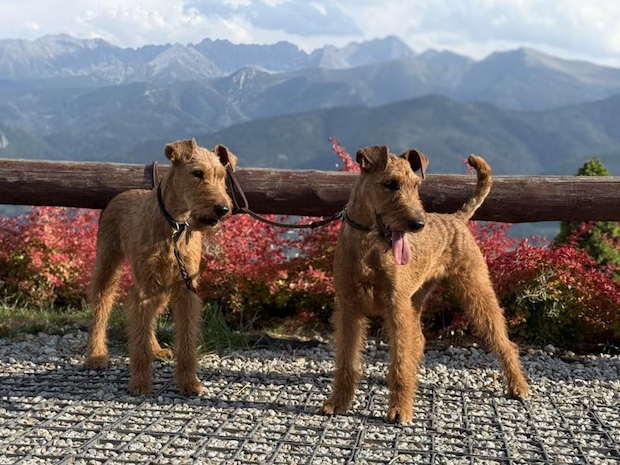
Photo of Agata Kucza’s Irish Terriers