Do you talk back to your computer?
We did on the occasion we came across information about a hunting dog said to run in circles, do backflips, and act “drunk” or playful near rabbit warrens. The colorful description is modern, but the core idea—a deceit‑hound that fools rabbits by pretending indifference—does come through in sixteenth‑century texts. The rabbits would watch the bizarre performance, mesmerized, allowing the Tumbler to slowly edge close enough to suddenly snatch them.
We’re pretty sure we muttered, “Seriously?” And the computer replied, “Totally.”
It didn’t, really, but it redeemed itself after we went down this rabbit hole (ha! a pun) to learn that in old British hunting texts, a “coney” was the traditional name for a rabbit. Estate warrens—carefully maintained enclosures and banks (read: man‑made) were stocked and protected so landowners with the right of “free warren” could harvest rabbits for meat and fur. “Coney hunting” simply meant rabbit hunting, but in a specific, managed context. The warrens were worked with a mix of ferrets, netting, and dogs, and some of the dogs were so specialized in how they worked that centuries later, someone (ok, us) learning about them said to no one in particular, “Seriously?”
In the 16th – 17th centuries, the height of the Tumbler’s working career, the dogs were described distinctly enough that scholars like Dr. John Caius gave them a Latinized name, Vertagus, corresponding to the English “Tumbler.” During the Tudor and Stuart periods, poaching became a highly organized underground trade, and a completely silent, deceptive dog was the ultimate tool for night hunters trying to avoid the gallows. This was a dog that took rabbits not by speed or nose, but by deceit via a pretense of indifference.
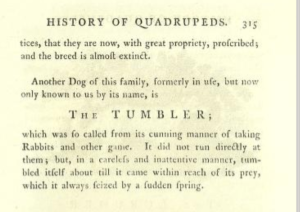
From “A general history of quadrupeds” by Thomas Bewick
The description of the Tumbler comes from Dr. John Caius, writing in the 16th century and later translated by Abraham Fleming in Of Englishe Dogges. Caius places the Tumbleramong the hunting hounds and immediately distinguishes it from the usual rabbit dog. When this little hound comes into a warren, he does not burst after the rabbits “with open mouth” like the others. Instead, he passes by them with what Caius calls “a certaine carelesse neglect,” behaving as though he has no interest in them at all. That feigned nonchalance is the entire trick. The rabbits, seeing no direct pursuit, fail to bolt. Only when the dog has drawn close enough does he drop the act and, with a sudden spring, seize his chosen rabbit. It is hunting “rather by craft than by any notable swiftnesse,” in Caius’s words—a wonderful phrase for anyone who loves purpose‑bred dogs.
Later naturalists like Thomas Pennant describe a small dog in his British Zoology that takes its prey “by mere subtility,” relying neither on great speed nor a remarkable nose, but on an intentional seeming disregard for the quarry until the moment of capture. Thomas Bewick, in A General History of Quadrupeds, includes the Tumbler as a distinct type and notes that it is so called from its cunning way of taking rabbits and other game. Between them, these writers preserve not just the name, but the reputation: a little dog whose job was to fool rabbits into standing still.
We have no idea what, if any, breed today can be linked to this ancestor. At best, what comes through text and a few period images is the sense of a small, active hound—lighter and nimbler than the greyhounds used for open coursing. Quick on its feet and built to move easily in and around warrens, one pictures a wiry, alert little opportunist.
Caius treats “Tumbler” as the English name for Vertagus and links it to the dog’s habit of tumbling or turning about in its work, noting a related French term that points in the same direction. By the late 18th century, however, the Tumbler was already receding into history. Other methods—ferrets, nets, and changing land use—became standard, and the need for a dedicated deceit‑hound faded away. The dogs seemed to dissolve into the background of unnamed rural dogs and vanished as a recognized kind. It is plausible that whatever blood they carried flowed on into the mixed, pragmatic small working dogs of the British countryside who were selected for function, not pedigree. From there, their influence may have brushed against later whippet‑like types; we admit that this is sheer speculation.
The Tumbler’s legacy survives in a handful of early texts as proof that long before we named tollers and decoys, hunters had already recognized that a dog’s mind—its ability to pretend, to mislead, to manipulate what prey thinks it sees—could be as potent a weapon as its legs or nose.
Seriously.
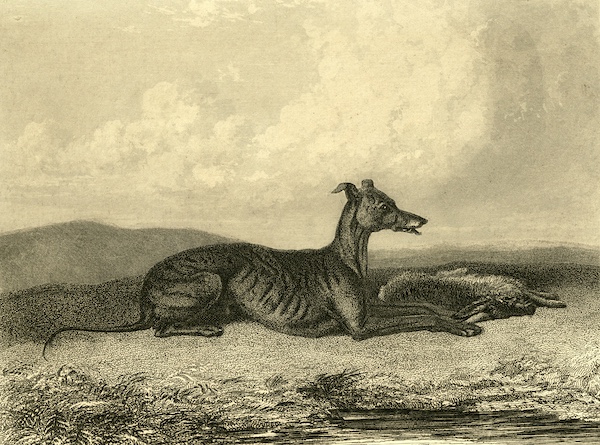
Image: Circa 1870 engraving, Greyhound and Hare/Contributor: Old Paper Studios/Alamy