Suet, molasses, some dry ingredients and nutmeg make a pastry dough to which raisins, currants, citrus zest, or dried fruit is added, giving the dessert a name sure to generate peals of laughter from grade‑school boys. But they aren’t the only ones to snicker. When Spotted Dick appeared as a challenge on the popular TV series The Great British Bake Off, competing bakers were tasked with producing perfectly light, steamed suet puddings studded with dried fruit and served with smooth, pourable custard—the very definition of old‑school British nursery food, and a minefield for undercooked centers and split sauces. Both the bakers and expert judges, Paul Hollywood and Prue Leith, clearly enjoyed the double‑entendre name even as they treated the technical demands of the pudding with complete seriousness. We should probably mention here that the word “dick” in this context is widely thought to be a dialect term for pudding, possibly related to older forms such as “puddick,” rather than to any modern slang.
In 1849, the celebrated chef Alexis Soyer published The Modern Housewife, which contains the earliest known written recipe for a suet roll “stuffed” with raisins and currants under the name “Plum Bolster, or Spotted Dick.” By mid‑Victorian times, “spotted dick” and “spotted dog” were common names for the simple, economical currant puddings that appeared regularly on British tables. With that culinary backdrop, it wasn’t much of a stretch for some to look at a Dalmatian and think of the old nursery pudding.
Over time, the Dalmatian picked up a collection of food‑driven nicknames in English. The Dalmatian Club of America has even noted that the breed has “as many native names” and that English speakers have called it the “English Coach Dog,” the “Carriage Dog,” the “Fire House Dog,” and—relevant to this post—the “Plum Pudding Dog.” Modern breed‑fact and lifestyle pieces repeat these nicknames and often add “the Spotted Dick” to the list, explicitly tying the dog’s round black spots to Britain’s famous currant‑studded suet pudding.
The joke didn’t stay in its lane of colorful nicknames. It eventually made its way into the names of actual Dalmatians recorded in canonical dog literature. In early‑20th‑century works on British dogs, authors mention a Dalmatian called Spotted Dick, owned by Mr. A. G. James of Kirkby Lonsdale and described elsewhere in the same literature as “Dr. James’s Spotted Dick. The author describes “Dr. James’s Spotted Dick” as “a dog not so good in contrast of colour, but superior in formation,” noting that he was associated with the influential Lakeside kennel of Mr. Newby Wilson of Windermere. Another Dalmatian chapter echoes that “it was at Kirkby Lonsdale that Dr. James’s Spotted Dick was bred,” using the name quite matter‑of‑factly as part of the breed’s developing show history.
This puts the dessert nickname squarely inside the serious, early‑show‑era Dalmatian world. “Dr. James’s Spotted Dick” appears in the same generation of British Dalmatian history that produced early exhibition dogs such as James Fawdry’s “Captain” and Newby Wilson’s “Champion Acrobat,” names that recur in late‑19th‑ and early‑20th‑century Dalmatian writing as the breed moves from the carriage road to the show ring. For at least one breeder and one chronicler, the pudding joke was good enough to etch into print and, presumably, into a stud book.
But imagine a top-winning Dalmatian making it to the Group lineup at a televised dog show, and the announcer saying, “And this is three-year old CH Spotted Dick from Ohio. He really stands out in a crowded field tonight for being a beautifully balanced, well-rounded specimen. There’s no fluff here—just a firm, traditional favorite that leaves a lasting impression on everyone who looks at him. Look at that effortless stride! He is not hiding a thing out there, just completely proud to show off what he’s got. And credit the person at the other end of the leash who knows exactly how to handle him to get the absolute best presentation under the lights.”
We hardly know when to stop. And were this any other audience than dog owners, we’d never dare to be so saucy.

Photo of one day old Dalmatians by Aleksandar Brendjan/Dreamstime
The irony in all this culinary wordplay is that while a “spotted dick” is “spotted” from the moment the batter is mixed with raisins and currants, a Dalmatian has to wait.
Dalmatian puppies are born pure white, with no visible spots at all, and their distinctive markings only begin to appear as tiny flecks after the first couple of weeks of life. Over the following months, those flecks darken—but did you know that their iconic spots are actually predetermined from day one, existing as hidden skin pigmentation? Dalmatian spots arise on an extreme‑white background created by variants at the piebald (white spotting) locus, with additional contributions from ticking and roaning loci that place pigmented spots back onto that blank canvas. A key gene called TYRP1 on chromosome 11 helps decide whether those spots will be deep black or rich liver, while other patterning genes control how many appear, how large they get, and where they land. Once a pup’s spots emerge, their individual pattern is essentially fixed for life, like a fingerprint.
Only when the markings finally come through does the “spotted dick” joke land: the British nursery pudding and the British coach dog meet in a single, unforgettable name—one that has followed the Dalmatian from Victorian kitchens to modern breed histories and right into the pages of classic canine literature.
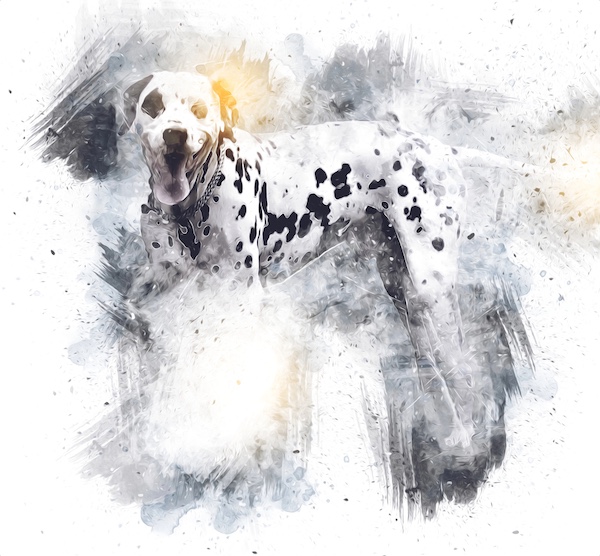
Image by maxtor7777 — a hand-drawn pencil illustration with digital coloring, styled in a beautiful vintage retro antique look/DepositPhoto