Did you know that the Mountain Chicken isn’t a chicken, but a large frog? Or that the koala — often called a “koala bear” — isn’t a bear at all, but a marsupial? How about the Titmouse? This isn’t a mouse but a bird. And our personal favorite? Rocky Mountain Oysters. Not an oyster. You’ll want to look that one up.
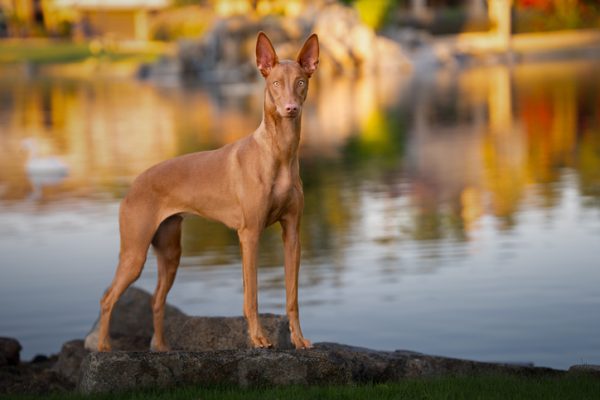
The Pharaoh Hound is another case of a name that points your imagination in the wrong direction. Despite the regal title, this is not a dog of palace courtyards insistent on royal treatment (though try telling that to a Pharaoh Hound), but Malta’s hard‑working rabbit dog whose original name, Kelb tal‑Fenek, simply means “dog of the rabbit.” For generations, these hounds have threaded Malta’s rocky garigue — scrubby, low‑growing vegetation over rough limestone — and rubble‑walled fields in pursuit of rabbits, prized by local hunters for their stamina, nose, and ability to work in difficult terrain. The “Pharaoh” part of the name suggests a neat link to the Valley of the Kings, but in reality it’s a romantic, myth‑and‑misunderstanding‑driven name layered over a very practical rabbit dog.
When Maltese rabbit dogs began arriving in Britain in the early 1960s, they were still known by names like “Maltese Hound” and Kelb tal‑Fenek, but the Maltese term was unfamiliar and awkward for English tongues. British fanciers, looking at the dog’s striking resemblance to hounds in ancient Egyptian art, leaned into that imagery. “Pharaoh Hound” fit the silhouette, sounded exotic, and seemed to confirm a long‑held belief that these dogs must have stepped straight out of tomb paintings, even though there was no solid historical evidence to support that leap. In 1974, The Kennel Club formally recognized the breed under the Pharaoh Hound name and approved a standard, effectively codifying the Egyptian story in an official document. From there, the title and its implied backstory were repeated in catalogs, show reports, and breed write‑ups around the world, reinforcing the idea that this was a dog of the pharaohs rather than a rabbit dog of Malta.
Only later did genetics start to test the story behind the name. A major study in the early 2000s that looked across dozens of breeds found that many supposedly “ancient” dogs are, in fact, relatively recent creations, and that Mediterranean hounds like Kelb tal‑Fenek do not stand out as direct survivals from pharaonic times. More focused genomic work comparing Kelb tal‑Fenek with the Sicilian Cirneco dell’Etna shows the two to be closely related and genetically distinguishable only within roughly the last two centuries — a timeline that points to regional selection and breed refinement, not to a 4,000‑year‑old royal bloodline. A 2023 phylogeographic study of hound‑like native dogs around the Mediterranean reports that Kelb tal‑Fenek is highly divergent from today’s Egyptian street dogs and finds no clear evidence that any of the breeds examined are direct descendants of Egyptian village dogs, while carefully noting that the data are not strong enough to completely rule out some distant shared ancestry. In plain language: the modern Pharaoh Hound doesn’t read in the DNA as a straight‑line descendant of dogs from the courts of the pharaohs.
So why does the myth persist? Partly because the silhouette really does look like the dogs in Egyptian art, and we humans tend to love a story that matches the picture it already knows. Partly because once kennel clubs, registries, and authors commit to a name, that name develops inertia; changing it is hard, especially when it’s romantic and, dare we say it, marketable. And partly because “Kelb tal‑Fenek, Malta’s rabbit dog” is accurate but unglamorous, while “Pharaoh Hound, Dog of the Pharaohs” is the kind of phrase one remembers. Just as “Mountain Chicken” misdirects you away from a frog and “Rocky Mountain Oysters” misdirect you away from what’s really on the plate (look it up), “Pharaoh Hound” misdirects you away from a tough, rabbit‑hunting farm dog and toward a palace dog that never existed — a reminder that in the animal world, the name doesn’t always tell the true story.
Image of a Pharaoh Hound by GoDogPhoto