How many times have we seen an exquisite example of a breed at a dog show only to see it passed over for Best in Show at an important dog show?
Big dog shows are a numbers game where hundreds of champion dogs are entered, but only one wins Best in Show. All that aside, there is a tacit understanding that certain breeds have an edginess hard to ignore in a show ring. The terrier leveling a “I double dare you to cross this line” flinty glare at another terrier tends to get our attention, while certain breeds known for their loyalty are intensely focused on their people and undeservedly fall under the Best in Show radar.
This isn’t to say it doesn’t happen, and certainly a few notable winners at Westminster prove it. But a Golden Retriever has never won Best in Show at Westminster. The closest was “Daniel” who in 2020 won the Sporting Group but was bested for Best in Show by a Standard Poodle name “Siba,” both exquisite dogs richly deserving of the honor.
Judging is subjective and an “on the day” evaluation, and we freely admit to having generalized thus far. That said, we maintain that some breeds, like the Labrador Retriever or the Mastiff—two breeds that also have never won Best in Show in Westminster’s over 100‑year history of awarding a BIS title—may be at a natural disadvantage when set against breeds whose very type seems to imbue a show‑ring edge.
In this post, we focus on the Mastiff, a breed described in a ShowSight article by Diane Collings & Toni Hyland as “not typically a ‘showy breed,'” a breed in which judges are advised not to fault a dog simply for being reserved or aloof during examination. Put another way, most casual observers would describe a Mastiff as enormous—not as a dog with ‘jazz paws,’ tap-dancing for the judge. What the breed offers instead is quiet, solid devotion to the person at the other end of the lead.
The danger, of course, is that quiet dignity can be mistaken for a lack of presence. In the Mastiff, presence is not expressed through animation. It is expressed through grandeur, breadth, depth, bone, balance and the impression of contained power. The breed standard does not ask for gaiety; it asks for dignity. Reserved is not fearful. Unshowy is not dull. Deliberate is not unsound.
A correct Mastiff shouldn’t need to manufacture an impression. His mass, symmetry, depth of body, heavy bone and powerful, well-knit structure should create it for him or her. Type and soundness require equal consideration, and equal weight; Mastiffs should be rectangular, massive and heavy-boned, height should come from depth of body rather than excessive leg.
Let’s discuss movement for a moment. “Quiet” does not mean lumbering, nor does dignity excuse poor movement. The Mastiff is a Working breed, and his gait should convey power and strength, with rear drive, smooth reach and legs that converge naturally toward the center line as speed increases.
Perhaps the Mastiff’s challenge in the final lineup is that the breed asks the judge—and the audience—to recalibrate what “showmanship” looks like. Its appeal is not a performance layered over breed type. At its best, the breed type is the performance: immense yet balanced, powerful yet docile, dignified without demanding attention. The Mastiff may not tap-dance for the ribbon, but it shouldn’t have to.
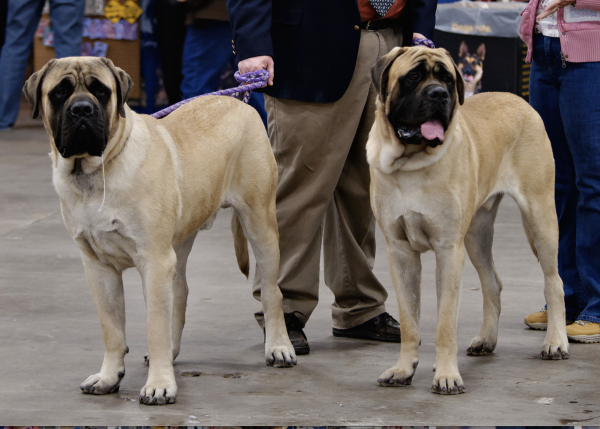
Photo of two Mastiffs at Louisville Kennel Club Dog Show 2008 by Dempster Dogs