
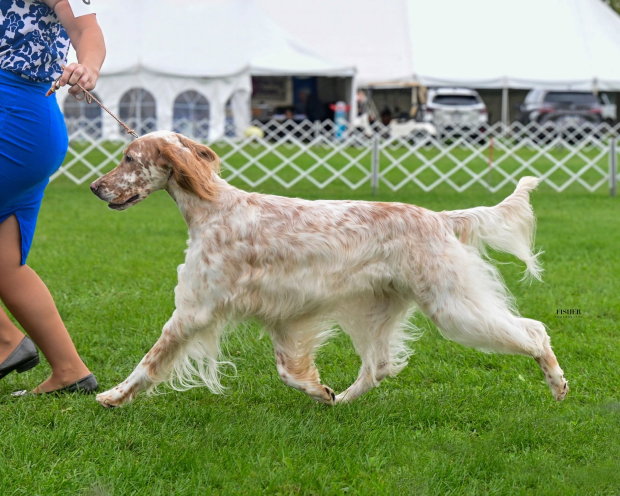
A special visitation takes place in the homes of English Setter preservation breeders a couple of weeks after a litter is born.
The Spot Fairy comes.
This Fairy doesn’t expect to find anything under a pillow or whelping pad, but like the Tooth Fairy, the Spot Fairy does leave something behind.
And it’s not a dime.
The Spot Fairy leaves behind (wait for it)…………..spots! And she continues to leave spots well into an English Setter puppy’s first year, if not longer.
“Spot Fairy” has a colorful ring to it, but we should note that it is technically inaccurate, because the word “spot” does not appear in the AKC breed standard — not even once. In the English Setter standard, the breed’s distinctive speckled or flecked coat pattern on a white ground color is called “belton.” That said, English Setter folks often use “Spot Fairy” with affection when the puppies start getting color.
Color, you say!
An English Setter can be described as blue belton, orange belton, lemon belton, or liver belton, depending on the color of the flecking (and as an aside, the term “belton” is breed-specific and comes from the English town of Belton where the dogs so marked were first seen. Lemon belton and liver belton are less common today, and if you’re ever in a situation where you are trying to tell lemon from orange belton, pigment can sometimes help, since lemon dogs typically have lighter nose leather and overall pigment than orange dogs. That said, eye color is not a simple stand-alone rule, and the breed standard describes the eyes as dark brown in general, with a lighter eye specifically acceptable in liver beltons. Setters with tan points are called tricolors. Those tan markings can appear in any of the color varieties, but they’re easier to see in blue beltons than in orange, lemon, or liver dogs. Tricolor is a specific genetic pattern, and all colors named in the standard are equally acceptable — none is preferred over another.
But better than to talk about it is to show you. Below are a few examples of puppies after the “Spot Fairy” visited Sharon Skelly’s household. We are so grateful to have her generous consent to share such educational photos!
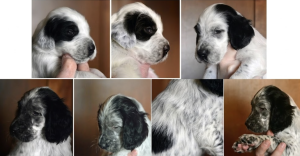
Below is a blue belton English Setter puppy, shown at different ages to illustrate how the belton pattern develops and intensifies over time:
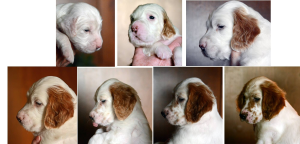
Here we have an orange belton boy:
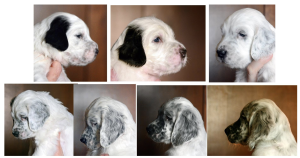
Followed by another blue belton puppy:
And finally, a little lass who is an orange belton, and is the same dog you see as an adult in the photo at the top:
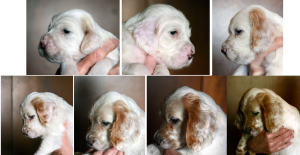
And then, of course, there is the gift that keeps on giving: the English Setter coat itself. As the puppy grows, the belton pattern continues to bloom and settle into its adult expression, with color deepening, feathering lengthening, and the whole dog gradually becoming more fully the elegant, feathered adult setter. The Spot Fairy may begin her work in a litter’s earliest weeks, but she does not vanish after the first visit; she keeps leaving her little calling card well into puppyhood, reminding us that in this breed, color is not a single moment but a lovely unfolding.
The image of the adult English Setter is of CH Northcoast Dipped In Amber RN TKN CGC VES1 (aka “Diva”) taken by Fisher Photography. All puppy photos were taken by Sharon Skelly