

You can’t really tell in the dogs above, but you sure can in the dog below:
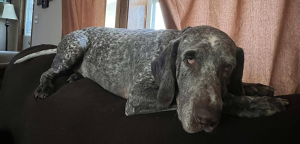
The sleepy beauty below also shows one off:
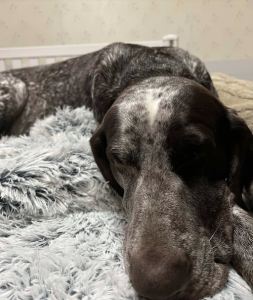
Did you figure it out?
Among the Perdiguero de Burgos’s calling cards, few are as charming—or as immediately noticeable—as the distinct white patch that often appears on the forehead. The official FCI standard calls it “a very frequent characteristic” of the breed’s coat, although it is not required, while the UKC standard similarly notes that “often there is a distinct white patch on the forehead.”
Set against a coat already composed of white and liver, irregularly patched or roaned, that little blaze can look almost like the breed’s signature.
The breed itself is thoroughly Spanish. The FCI lists its country of origin as Spain, while its name points more specifically to Burgos, the northern Spanish province and city with which the breed is associated.
The UKC describes the Perdiguero de Burgos as an old Spanish pointing breed that has existed since the 1500s. Its history is tied chiefly to quail, partridge, and hare, though the UKC also says it was used as a specialist on deer for most of its history.
The forehead mark is not a separate color or a requirement for breed type. It is simply a frequently occurring part of the breed’s accepted white-and-liver pattern.
The FCI standard describes the coat’s two basic colors as white and liver. These may mix irregularly to produce liver-marbled, greyish-liver, or liver-speckled effects, depending upon which color predominates and the size of the patches.
Liver-colored hairs may form distinct patches distributed over the body, while white hairs may also collect into patches, although these are generally not extensive. The ears, however, are always self-colored liver.
Genetically, the precise cause of the Perdiguero de Burgos’s forehead patch does not appear to have been established in a breed-specific study. In dogs generally, white spotting is often associated with variants involving the MITF gene, but the inheritance and expression of white differ considerably among breeds.
UC Davis explains that some breeds show dosage-dependent white spotting from MITF-related variation, while in others white patterning follows a different inheritance model, so the amount of white cannot be read from the gene alone.
It is therefore reasonable to view the Burgos forehead patch as part of the breed’s broader white-patterning, but it would be premature to assign it to a particular variant—or to call it the product of a single “spot gene”—without genetic research specific to the breed.
Whatever lies behind it genetically, the mark has become a memorable part of the Perdiguero de Burgos breed picture. It does not make the dog a Burgos, nor is it necessary for a dog to possess it. But when that little white patch appears above the eyes, it adds one more distinctive touch to an old Spanish pointing breed whose coat is already a handsome mixture of liver, white, patches, and roaning. Personally, we think it’s the “kiss here” spot.
For breed people, that is part of the fun: a small white blaze on the forehead, set against centuries of Spanish hunting history.
All photos are by Adriene Capetillo and are shared with her kind consent