
You don’t see this much anymore, but there was a time when showing a brace or a team in a show ring wasn’t rare. Most fanciers remember the first time they saw a team being handled, and for our part, watching Nadine Anne Johnson handle four magnificent Borzoi was unforgettable. Few people could have created the same snapshot as Nadine did since she was as tall, lithe, and elegant as her dogs.
A brace, of course, is when a pair of dogs are shown, as identical to each other as possible. But here we’ve gone and strayed from our intended topic, “collective nouns.” We lament the fact that each breed doesn’t have its own collective noun, though it is amusing to come up with them. That said, there is one breed that does have a collective noun, an expression that predates organized dog shows by centuries and comes straight from the hard-working vocabulary of English hunting and coursing.
The expression is a “leash of Greyhounds.”
Modern fanciers did not invent the term, nor—so far as surviving records reveal—can it be credited to a single person. “A leash of Greyhounds” belonged to the specialized language of those who kept, trained, led, hunted, and coursed hounds long before the first formal dog show. The expression was already established by 1486, when the Book of St. Albans, an early printed English compilation of hunting, hawking, and heraldry lore, listed “a brace of greyhounds of two” and “a lece”—an early spelling of leash—“of greyhounds of three.”
That is the important part: a leash of Greyhounds was never a cute phrase dreamed up to make a list of animal-group names more amusing. It was a practical term. A brace meant two Greyhounds, while a leash meant three. The distinction was useful to people who worked with dogs and needed clear, commonly understood language in the kennel and in the field.
Why leash? The answer is quite literal. A leash was a cord, thong, or strap used to lead a dog, especially a hound. The word could refer to the actual leading line and, over time, to the customary number of animals connected with it—three. Older sporting and hunting texts use related forms such as lease, lece, lesia, lyam, and lime, all reflecting the language of leads, lines, and hound handling. Historical sources identify lesia as a leash of Greyhounds, while related terms referred to a line used in managing hounds.
Greyhounds were, of course, central to coursing, the ancient sport in which a sight hound pursued game it saw rather than tracked by scent. Coursing developed its own specialized vocabulary, personnel, practices, and rules. By the sixteenth century, formal English coursing rules were known as the Laws of the Leash, traditionally associated with Thomas Howard, Duke of Norfolk. The name preserves the close relationship among Greyhounds, their leads, and the field sport for which they were prized.
That does not mean that Greyhounds always coursed in threes. In the familiar form of hare coursing, two Greyhounds were slipped together after a hare, and that pair could properly be called a brace. But a leash remained the recognized term for three Greyhounds, and the word carried both its numerical meaning and its association with the strap or string by which the dogs were controlled.
The old terminology endured. An 1800 Sporting Dictionary included “a brace of pointers” and “a leash of greyhounds,” though it allowed that custom could sometimes vary. More than a century later, a 1919 Daily Racing Form article, “Some Queer Old Sporting Terms,” explained the usage in similarly plain terms: in the old sporting language applied to hounds and Greyhounds, three Greyhounds made a leash, while two hounds made a couple—or, in the case of three, “a couple and a half.” It also noted that the string used to lead a Greyhound was called a leash.
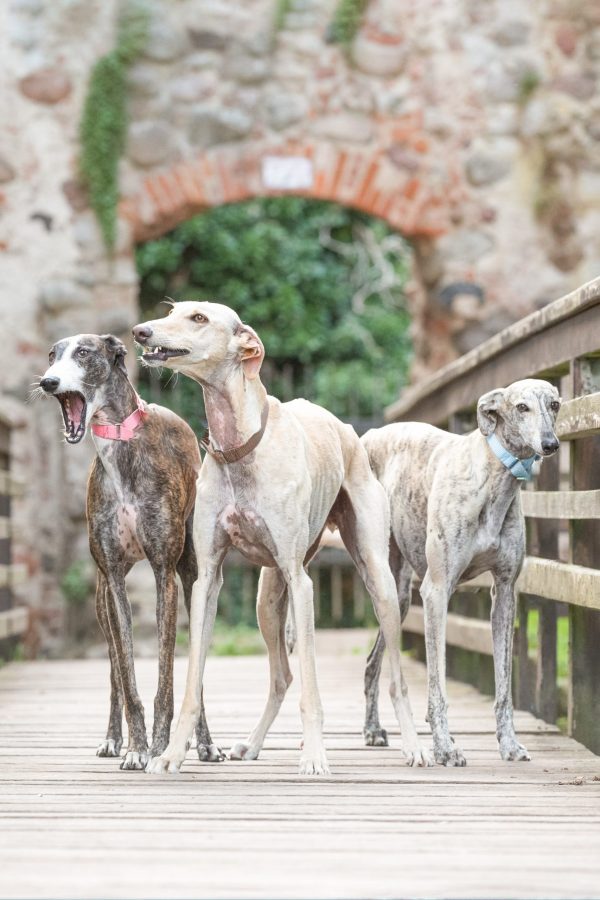
So when three Greyhounds stand together—whether in an old sporting print, an elegant photograph, or perhaps awaiting their turn at a specialty—they are more than a group of dogs. In the language of the coursing field, they are a leash: a term shaped by use, history, and the practical realities of handling remarkable hounds.
Image by Dürken Abb from Pixabay
Hi..!
Loved reading this, very educational and interesting,
Thank you
Jase
Thanks for that! We figure our readers love this stuff as much as we do!