
Why is this sculpture so darn important?
For breed enthusiasts, historic art can be far more than decoration. Paintings, prints, and sculpture offer glimpses of the dogs people knew at a particular moment in time: which recognizable breeds or types existed, how they looked, and sometimes even how they were regarded in society. A dog trotting beside a carriage, sitting on a lady’s lap, accompanying a hunt, or appearing in a grand domestic setting may suggest its role as a working partner, sporting dog, fashionable possession, or cherished companion.
But the eighteenth-century sculpture seen here—Shock Dog by Anne Seymour Damer—is important for another reason. It was made by Britain’s first woman sculptor to achieve major prominence, an extraordinary accomplishment in Georgian Britain, when sculpture—particularly marble carving—was considered a male domain. Women might be encouraged to embroider or paint bucolic watercolors, but public recognition as a sculptor was exceptionally difficult for them to attain.
Damer nevertheless exhibited 32 works at the Royal Academy between 1784 and 1818 as an honorary exhibitor, an unusual public career for a woman of her social position. In 1784, she became the first woman sculptor to exhibit marble statues in the Academy’s annual exhibition.
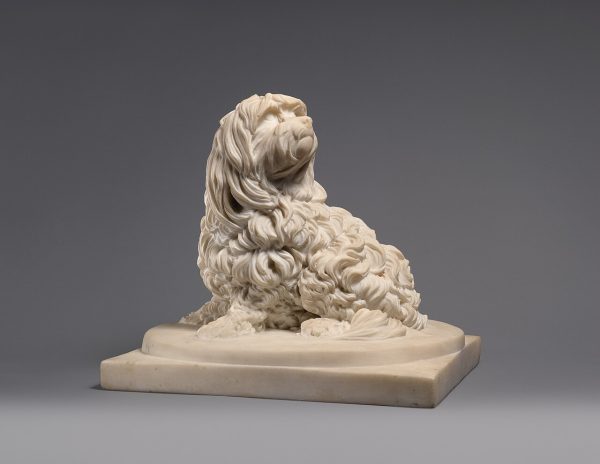
Damer’s Shock Dog shows why contemporaries took her work seriously. The life-size depiction of a small dog—seated, attentive, and gazing upward as though waiting for a word, touch, or treat—is not a generic animal study. The animated pose, deeply worked coat, and palpable expectancy make the dog feel like an individual with a relationship to someone just outside the frame.
The sculpture’s title, Shock Dog, used a contemporary nickname for a small, rough-coated companion dog often associated with the Maltese. The term referred to the animal’s shaggy or tousled coat. That abundant coat gave Damer an ideal opportunity to demonstrate her remarkable command of texture, whether working in marble or terracotta.
One of the most influential arbiters of taste in eighteenth-century Britain, Horace Walpole praised Damer’s treatment of the dog’s coat for its “looseness and softness,” qualities he thought astonishing in terracotta. Damer did not invent animal portraiture—British artists had been portraying cherished animals since the early eighteenth century—but she became an important specialist in sculptural pet portraiture. Her work gave domestic animals both emotional presence and technical authority in the world of art.
Shock Dog also challenged the notion that eighteenth-century “serious” sculpture had to portray grand historical subjects. Damer invested a small household dog with the presence and individuality normally associated with human portraiture. The piece records a dog not merely as an ornament or symbol of affluence, but as a familiar presence with a recognizable personality—in short, a companion.
Two notable versions of Damer’s composition survive. The Metropolitan Museum of Art owns the Carrara-marble Shock Dog of about 1782. A second, life-size terracotta version, signed and dated 1795, was sold at Sotheby’s in 2025. It remains in private ownership, with the buyer undisclosed. A temporary UK export bar was placed on the sculpture in January 2026 to give a British institution time to acquire it. At the time of writing, no public announcement of a permanent institutional acquisition has been made.
So perhaps you can now see why Damer’s Shock Dog matters. It demonstrates a woman artist’s exceptional achievement in a demanding medium, gives a domestic pet the close observation and character traditionally associated with portraiture, and preserves an affecting glimpse of the bond between people and their dogs more than two centuries ago.
Anne Damer died on May 28, 1828, and was buried at St Mary’s Church in Sundridge, Kent, beside her mother. We conclude with a personal detail that we think says volumes about the artist. According to the Metropolitan Museum of Art, Damer asked to be buried with her sculptor’s tools and the bones of her favorite dog—two lifelong joys that had sustained her.
Image: Shock Dog by Anne Seymour Damer, c. 1782. The Metropolitan Museum of Art; image via Wikimedia Commons, public domain.