
Colombia is one of the world’s megadiverse countries. Although it occupies a relatively small share of Earth’s land area, many scientists believe it to be home to nearly 10 percent of known species, across Caribbean and Pacific coasts, Amazonian forest, Andes, tropical lowlands, and high-elevation páramo ecosystems. Wow.
It is also a country of imported purebred dog breeds and perros criollos*, but only one formally recognized native breed stands apart: the Colombian Fino Hound. Known at home as the Sabueso Fino Colombiano, this rangy, long-eared scent hound was shaped by generations of work across Colombia’s mountains, lowlands, and rough rural country. Its nose, stamina, and far-carrying voice made it a practical hunting dog when a successful trail could mean food on the table. Today, it holds a singular distinction as Colombia’s only formally recognized native dog breed—and, since February 2026, an FCI-provisionally recognized scent hound.
*The country’s perros criollos are locally adapted mixed-breed and village dogs rather than a single standardized breed. Alongside them is an active purebred-dog community centered on the Asociación Club Canino Colombiano (ACCC), Colombia’s FCI member kennel club. In 2025, the ACCC reported 97 individual members, 11 affiliated breed, regional, or sporting clubs, 48 all-breed CAC shows, and 1,598 puppies registered in its studbook. More than 91,000 purebred dogs have been recorded in the studbook since its creation. Within this varied canine landscape, the Fino is Colombia’s only formally recognized native breed.
The Fino is not a recently manufactured “rare breed,” but a Colombian-developed hunting hound shaped over generations by geography, necessity, and a practical need for a dog capable of following game through difficult country. Its history is generally traced back at least two centuries, with ancestors likely arriving through successive introductions of European and North American hunting dogs. Imported scent hounds supplied the principal trailing foundation; later hound stock, including Foxhound-type dogs associated with British influence, is also believed to have contributed.
Across Colombia’s mountains, jungles, lowlands, and isolated rural regions, these dogs developed regional variation while retaining a recognizable identity: a medium-to-large, short-coated, long-eared hound with an exceptional nose, endurance, and a voice suited to work over distance.
The voice matters. The Fino’s traditional role was hunting—sometimes sport, but, in many rural settings, a practical means of finding food. A good dog could trail quarry through dense cover, persist over difficult ground, and serve as a reliable working partner when a successful hunt helped put food on the table.
That working background makes the Fino part of Colombian history, not simply another hound. It represents a scent hound developed in Colombia for hot, rugged, and varied terrain. Someone may choose a Fino when they want an athletic, people-oriented trail hound with a distinctive cultural pedigree, a strong natural nose, a low-maintenance coat, and the capacity to excel in outdoor and scent-centered activities.
Affectionate, friendly, playful, intelligent, and responsive to its people, the Fino is still thoroughly hound: capable of independent decision-making and likely to become single-minded when a compelling scent or chase opportunity appears. Put another way, you have the Fino’s attention—until a scent becomes more interesting than you are. A secure fence, leash management, consistent training, and ample daily exercise are therefore necessities, not extras.
Recognition of the breed has advanced substantially. Colombia’s national kennel club, the Asociación Club Canino Colombiano, recognizes the Fino, and the Fédération Cynologique Internationale accepted the breed on a provisional basis effective February 11, 2026. The FCI assigned the Sabueso Fino Colombiano Standard No. 376 in Group 6, Scent Hounds. Provisional recognition is a significant step, but it is not final recognition: provisionally recognized breeds cannot compete for CACIB until the FCI grants definitive recognition, although they may be eligible for certain FCI titles.
We hesitate to guess population numbers. We’ve seen a figure of approximately 10,000 Colombian Fino Hounds in Colombia as of 2015 often repeated, but we suspect it’s best treated as an estimate rather than a current global census since the former doesn’t exist (not that we found, anyway). We do sense that the breed remains uncommon outside Colombia.
For Colombia, the Fino is more than a newly recognized breed: it is a living reminder that a country’s canine heritage may be found not only in show rings and studbooks, but also in the stories of its people. Many believe the Fino to be a symbol of Colombian rural culture.
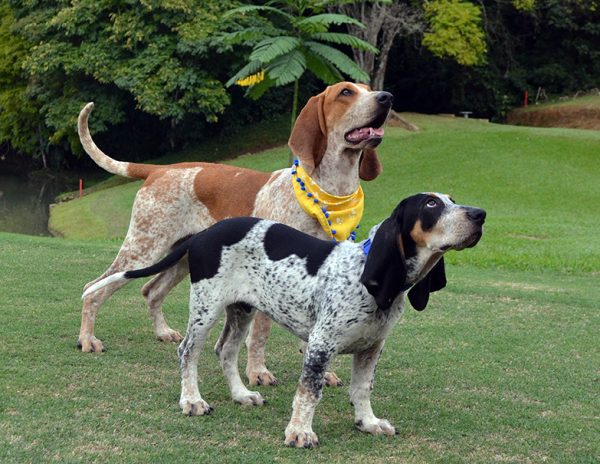
As for our image: Readers accustomed to tightly standardized show breeds may be surprised by the Colombian Fino Hound’s range of appearance as evidence in the photo at the top. One Fino may be a tall red-and-white hound; another may be smaller, black-and-white, and densely ticked. That diversity is not a sign that they are different breeds. The FCI standard recognizes both Standard and Large size varieties, smooth- and wire-haired coats, and an unusually expansive range of accepted colors and markings. What unites the Fino is its functional hound type—long ears, athletic outline, scenting ability, stamina, and a voice made to carry—rather than a narrowly uniform color or silhouette. The photo is by D1090and shared/licensed under CC BY-SA 4.0.