The breed was often a child’s first playmate, and when it got a little older, it might help guard the homestead. Once a full-on adult, however, its defining purpose was to hunt. In the mountainous “spine” of Italy known as the Apennine Mountains, the steep, difficult country functioned as a proving ground for these dogs, their breed recently becoming one of the newest breeds in the international registry system.

Photo of Il Gran Sasso d’Italia, il Paretone. The east face of Corno Grande by Lucio De Marcellis and shared under the terms of the GNU Free Documentation License
The breed’s official FCI English name is the Appennine Hound–Italian Hare-Hunting Dog (Segugio dell’Appennino in Italian) and though it may be one of the “new kids on the FCI block,” the breed has a documented identity extending back at least 144 years, and the actual working population was almost certainly older. Dogs of this kind worked for generations in rural Italy before anyone attempted to define them through a written standard and pedigrees. Make no mistake, however. The Appennine Hound is not a general all-purpose Italian hound that hunts hares. Everything about this breed — from its structure, temperament and voice — to its working method was shaped by the demands of finding and pursuing hare through difficult hill and mountain country. These hounds had to be light enough to travel quickly over broken slopes, tough enough for thickets and changeable weather, independent enough to locate a hare without constant direction, but sufficiently connected to its handler to work at a distance without becoming lost or uncontrollable. Selection was almost entirely practical. A hound that couldn’t locate and pursue a hare was of little value to its owner.
The Apennines stretch for roughly 750 miles through the Italian peninsula — a topography in which a lightly built but insubstantial dog would fail, just as a powerful but lumbering one would.
But the Appennine was not confined to one little valley bearing its name. According to the Italian Kennel Club, dogs recognizable as today’s Segugio dell’Appennino were once used throughout Italy, from Calabria northward to the country’s eastern and western extremities. Their appearance could vary from one region, district or village to another because – logically – hunters cared more about performance than appearance. Beneath those regional differences, however, a remarkably consistent physical type emerged because that’s what it took to do the job: a light, agile, muscular dog built to maintain its balance and speed on steep and broken ground.
As far as we can tell, the earliest printed description of the breed showed up in the illustrated hunting journal La Caccia on November 2, 1882, where the dog was included among the scenthound breeds existing in Italy. We are supposing that this doesn’t mean the breed was created in 1882, but that it was sufficiently recognizable to be described as a distinct breed.
In 1932, Filippo Zacchini, a lawyer/farmer/breeder and hare-hunting enthusiast, described the dog as a small hound of exceptional agility and liveliness, “all muscles and nerves,” without heaviness. He considered it a dog of ancient origin with a set type already in place. Zacchini noticed that it was mostly small landowners living in the country that kept these dogs.
But like so many of our breeds, much of the Appennine Hound’s history is of a dog bred outside clubs, registries, dog shows, or even standards. It was Italian farmers and hunters who commonly raised the dogs freely until maturity and then chose their hunting dogs based on ability. The Italian Kennel Club describes the traditional principle that hunters followed when breeding their dogs as “bravo × bravo”—breed a capable worker to another capable worker. Color, coat texture and other cosmetic details remained largely unimportant because they did not affect the dog’s ability to work.
Modern DNA investigations cited by the Italian Kennel Club indicate that this selection was conducted without systematic reliance on close inbreeding. That helps explain why regional strains could differ superficially while retaining the physical construction, hunting instinct and behavior necessary for the same specialized work.
The traditional Appennine Hound was expected to perform all four phases of hare hunting. It had to search where hares lay up at night, figure out a diminishing scent trail, find and flush the hiding animal, and then go after it by scent while giving voice.
The best description we found of this breed is that a complete hound has to solve the entire puzzle for itself.
That said, hounds were still expected to maintain contact and cooperate with their canettiere, or hound handler (read: owner). These dogs traditionally hunted alone or maybe in a pair, and while we found references to hunting wild boar, hare has always been the breed’s main quarry.
We will have more to say about the breed’s personality and phenotype very soon, but for now, we pivot to the breed’s journey toward formal recognition.
Italian enthusiasts, hunters and the Società Italiana Pro Segugio worked with the Ente Nazionale della Cinofilia Italiana, or ENCI, to document the population, define its characteristics and establish a written standard. ENCI now includes the breed in the Italian genealogical register and identifies it as one of Italy’s native breeds.
The FCI (Fédération Cynologique Internationale) accepted the Segugio dell’Appennino on a provisional basis on February 11, 2026, and placed the breed in Group 6, Scenthounds and Related Breeds. Note that provisional recognition is real FCI recognition, but it isn’t definitive recognition. Dogs may receive pedigrees bearing the FCI logo and may compete for certain FCI titles, including World and Section Show winner titles, but they aren’t yet eligible for the CACIB, the international championship certificate, until the breed achieves definitive status.
As we write, ENCI and the FCI system are the breed’s principal formal registries. The Appennine Hound isn’t listed with the AKC, United Kennel Club, Canadian Kennel Club or Royal Kennel Club. FCI recognition does, however, give the breed solid standing in the international network of FCI member and contract-partner kennel organizations, subject to their respective registration procedures. Put another way, it helps.
We welcome the Appennine Hound to the world arena of acknowledged breeds.
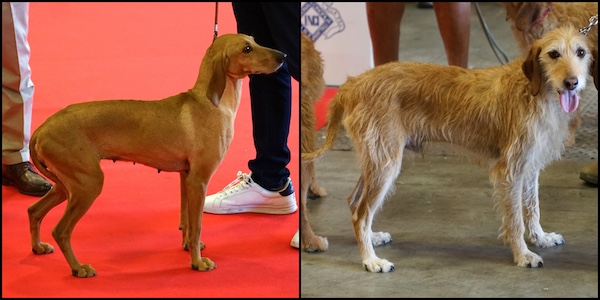
Photos: ‘Apennine Hound, rough-haired,’ and “Apennine Hound, short-haired” by Canarian, via Wikimedia Commons, licensed under CC BY 4.0. Collage adapted from the originals