
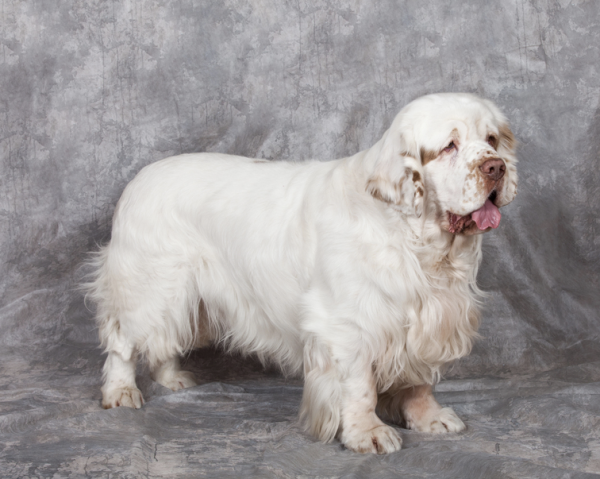
How do we really know that our breed looks anything like it did hundreds of years ago? If it could look back at us across the centuries, would we still recognize it?
In the case of the Clumber Spaniel, we can answer with unusual confidence because a 238-year-old painting offers persuasive evidence—and a compelling argument for established type. Francis Wheatley’s 1788 painting Return from Shooting preserves what is believed to be the earliest known depiction of the breed—four unmistakably Clumber-like dogs shown on the very estate that gave them their name.
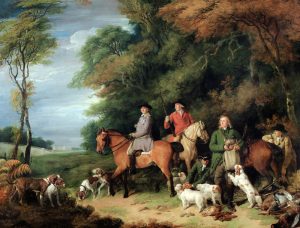
But Wheatley’s painting records more than their appearance at the time. These dogs weren’t decorative accessories to an aristocratic family. They were depicted as part of a returning shooting party, portrayed in the landscape in which their particular combination of substance, stamina and deliberate movement had a purpose.
That landscape was Clumber Park, the Nottinghamshire seat of the Dukes of Newcastle. Exactly how the breed began remains less certain than the dogs in Wheatley’s painting. The familiar story known to most Clumber owners —that the French Duc de Noailles sent his spaniels to the second Duke of Newcastle around the time of the French Revolution—is often repeated — but breed historians are less certain because no contemporary documentation that we found has been found to substantiate the exchange, and Wheatley’s painting shows that a recognizable Clumber type was already established at the estate before the Revolution began.
What is known is that dogs of recognizable breed type were established in the Duke’s kennels by the late eighteenth century, and that his gamekeeper, William Mansell, is closely associated with their development. Mansell served the second Duke for roughly 30 years and is generally credited with developing the Clumber as a sturdy, capable dog for the dense cover around the estate. For a time, such dogs were known as “the Duke’s breed” or even “Mansell’s breed.”
The dogs eventually took the estate’s name, but they earned their keep in its coverts—the dense woodland and undergrowth where game sheltered. Built low, long and powerful, Clumbers worked slowly and methodically through thick vegetation, using their excellent noses to locate and flush game for the guns. Their predominantly white coats made them easier to follow in the undergrowth, but it was their substance that enabled them to power through it.
That talent for shouldering aside whatever stood between dog and game reminds us of the McConnel ROBOCUT robo-mulcher Jeremy Clarkson unleashed on his farm in Season 3 of Clarkson’s Farm: low-slung, powerful and seemingly capable of advancing through anything in its path. The Clumber was its 18th-century canine counterpart—less destructive, certainly, but similarly built to go where something lighter might be stopped.

Clumber Park was purchased by the National Trust in 1946 with the aid of public donations and opened to visitors in 1951. Although Clumber House is gone, the landscape remains remarkably legible: its lake, woods, heath, chapel, walled kitchen garden, estate buildings, and the Ornamental Bridge still evoke the world in which the breed developed. The breed’s storied past has been celebrated annually since, to our knowledge, 2015. On Sunday, June 14, 2026, more than 60 Clumbers gathered at the park for the annual Walking With Clumbers gathering. The day included a group walk, a tree-planting ceremony, and the unveiling of new interpretation boards about the breed. For a breed with comparatively few dogs born in Britain each year, it was a chance for owners to meet—and for dozens of Clumbers to reclaim, at least briefly, their ancestral ground.
Walking with the Clumbers has a Facebook page that shares information about Clumber Spaniel Walks held in various parts of the UK; their “Upcoming events” tab reveals a host of activities planned throughout the rest of 2026.