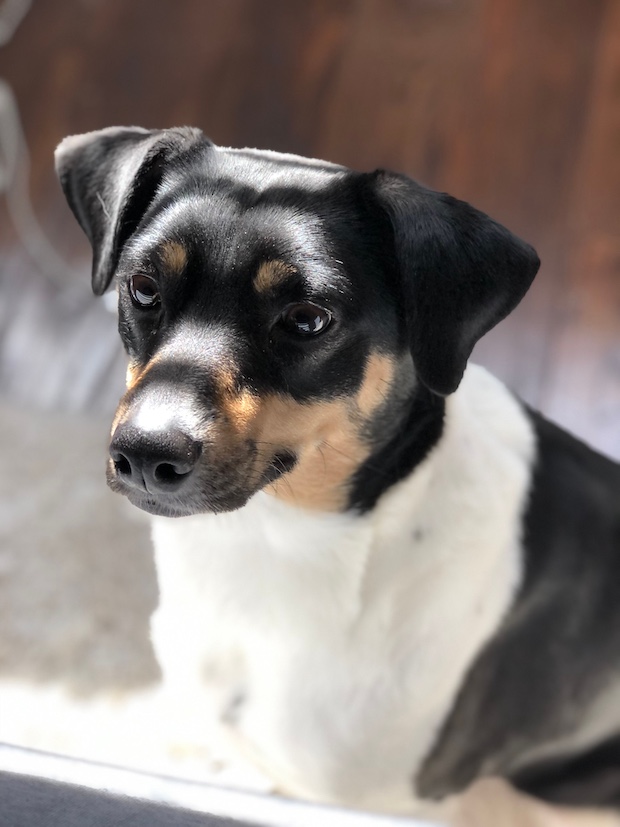
Few breeds have such a complete relationship with a city as does the Ratonero Bodeguero Andaluz with Jerez de la Frontera, Spain — or, as the FCI lists it in English, the Andalusian Terrier (or Sherry Terrier).
How that bond runs deep shows up in both numbers and civic language. CERBA, the national breed club, put the microchipped population at roughly 52,000 dogs across Andalusia as of 2024, concentrated in the provinces of Cádiz, Huelva, Sevilla and Córdoba, even as the breed has spread into pet-owning households nationwide (source: Ayuntamiento de Jerez; El País).
Jerez’s own municipal materials go further than the 2020 heritage vote alone: the city describes the dog as a “zootechnical jewel” of its municipal patrimony, ranking it alongside wine, horses and flamenco as a full ambassador of local identity, and states that it may be the only breed anywhere bound this closely to one specific city.
High praise!
The dog was shaped by one region’s wine trade. English merchants trading sherry brought terriers, principally Smooth Fox Terrier lines, into Spain’s Marco de Jerez during the 19th century; those dogs crossed with local stock from Cádiz province, in Andalusia in southern Spain, into a lean, fast ratter for the sherry triangle of Jerez de la Frontera, Sanlúcar de Barrameda and El Puerto de Santa María (FCI-Standard No. 371; Sherry.wine). Breeders favored a predominantly white body, with black markings concentrated on the head and neck and tan points on the face, cheeks and above the eyes, so the dogs stood out in the dark bodegas, warehouses, stables, tanneries and commercial ports where they hunted rodents.
Spain recognized the breed in stages. The Real Sociedad Canina de España approved the breed and its standard around 2000; the government’s own listing of it as a native breed is documented by an August 2, 2001 Ministry of Agriculture order in the state gazette. On September 30, 2020, Jerez’s municipal council groups voted unanimously to name the breed Intangible Cultural Heritage of the City, backed by CERBA, the national breed club, though CERBA itself did not vote. Spanish media called it the first Spanish breed to receive that status, and Jerez itself has called the move “pionera”.
The FCI’s two names work at different scales: “Andalusian” for the region, “Sherry” for the city. “Sherry,” we learned, is a mistaken singular of the older “sherris” (1530s), from Spanish “(vino de) Xeres,” the old spelling of Jerez (etymonline) — the wine’s name and the dog’s name trace to the same word.
Accepted by the FCI on a provisional basis September 3, 2024, the breed may compete for the CAC but not the CACIB, and the club cannot even apply for definitive status until ten years after provisional acceptance.
Whatever the precise details of its arrival — and even CERBA’s own leadership hesitates at parts of the popular founding story, describing the English connection only as the “probable” origin — the identity that stuck was Jerez’s, not England’s. Local press has taken to calling it simply “el perro más jerezano,” the most Jerez dog there is (La Voz del Sur), and each September the city renews that claim: at this year’s Pisa de la Uva, the ceremony that opens the Fiestas de la Vendimia, the breed was honored again for its “historic and indispensable” role in the bodegas that built Jerez. Wine regions everywhere have mascots. Jerez may be the only one with a breed standard.