Few Afghan Hound terms invite more misunderstanding among the uninformed than saddle. In general dog terminology, a saddle may describe a darker, saddle-shaped area of color. That is not what the word means in the Afghan Hound standard.
In the Afghan, the saddle is a natural coat feature: the short, mature hair flowing over the back of the mature dog. It is neither a color marking nor an effect to be created with clippers, thinning shears, or scissors (yikes!) The correct saddle develops naturally.
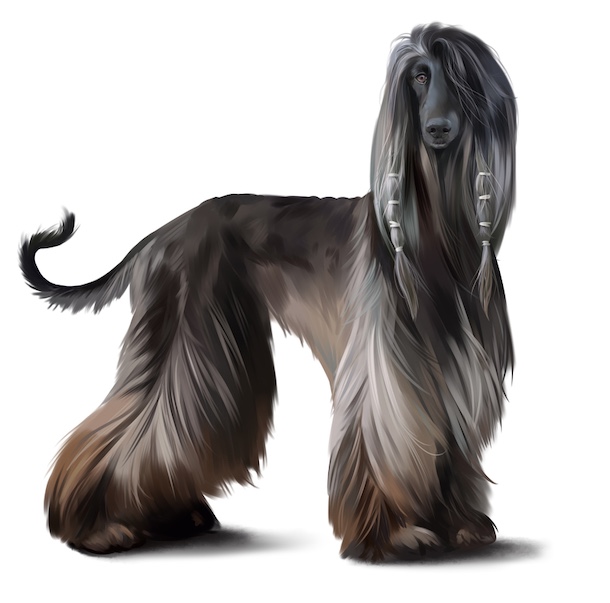
The Afghan Hound is famously elegant, a mature flowing coat accentuating its beautiful lines, but the breed’s coat is not intended to be the same length and texture from head to tail. The AKC standard calls for thick, silky hair of very fine texture over the hindquarters, flanks, ribs, forequarters, and legs. The ears and all four feet are well feathered. It then describes short, close hair in front of the shoulders and, from the shoulders backward, along the saddle from the flanks and ribs upward. That back-coat pattern produces the smooth back of the mature Afghan Hound, which the AKC identifies as a traditional breed characteristic.
The contrast is part of the Afghan’s distinctive silhouette. Long, flowing furnishings frame the short-coated back and help create the elegant outline associated with the breed. The saddle is therefore a coat-pattern feature, not a matter of color or a stylistic grooming choice. A dog’s color may affect how readily the pattern is seen, but color neither creates nor replaces the natural short-haired saddle.
The standard’s use of the word mature matters. Afghan Hounds do not emerge from puppyhood wearing a fully finished adult coat. Development of the mature coat pattern takes time. The AKC specifically lists lack of a shorthaired saddle in mature dogs as a fault, and UKC likewise lists absence of the short-haired saddle in a mature dog as a fault (note that neither standard treats its absence as a disqualification).
The UKC usefully distinguishes the saddle from the short hair found farther forward. Its standard notes patches of short hair on each side of the neck in front of the shoulders, generally covered by the profuse neck coat. It then describes the coat from the shoulder backward across the top of the back as short and close. This is the area generally recognized as the saddle.
The Royal Kennel Club (formerly the Kennel Club) uses similarly direct language: “In mature dogs, from the shoulder backwards and along the saddle, hair short and close.” Its standard further requires that the coat develop naturally and says that any evidence of clipping or scissoring is undesirable.
The grooming provisions are not an objection to conscientious coat care. Afghan Hounds we see in a show ring require management to keep their coats in proper order. The distinction made by the standards is between maintaining a naturally correct coat and altering it to simulate a feature the dog has not developed. The AKC says the Afghan Hound should be shown in its natural state and that its coat is not clipped or trimmed. UKC says the breed is presented in natural condition and strongly discourages trimming used to artificially create the characteristic coat pattern.
For breeders, exhibitors, judges, and anyone learning to read an Afghan Hound, the saddle offers a revealing lesson in breed type: it cannot be found on a color chart or manufactured in the grooming room. The true Afghan saddle is grown, not groomed—a natural sweep of short, close coat along the mature dog’s back that sets off the breed’s flowing furnishings and unmistakable silhouette.