Longtime readers know of our fondness for archaic terms found in crusty old dog books, but we also appreciate the colorful descriptions preserved in breed standards. Some of these marvelous expressions survive from earlier standards written in the breed’s country of origin, before standardization encouraged a certain economy of words.
We were therefore amused to discover that, in at least one breed, the American standard may be more elaborately tailored than its British counterpart.
We refer to the Schipperke.
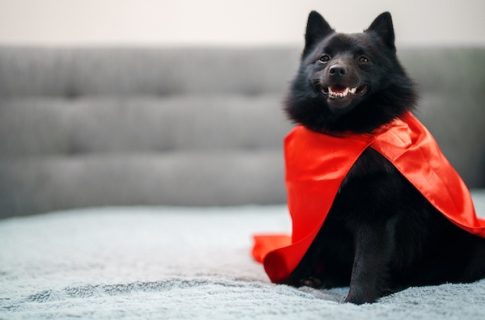
The AKC standard employs enough clothing vocabulary to outfit this little Belgian dog for a formal occasion. Its distinctive adult coat includes a ruff, cape, jabot, and culottes—each term identifying a naturally occurring section of coat:
-
The ruff begins behind the ears and completely encircles the neck.
-
The cape is an additional layer extending beyond the ruff.
-
The jabot extends across the chest and down between the forelegs.
-
The culottes are formed by the longer coat on the backs of the thighs.
These are not grooming effects manufactured in the show ring. The adult Schipperke’s coat is meant to grow in several distinct lengths and in a particular pattern. The AKC standard considers that differentiation an essential breed characteristic and says that a coat lacking sufficient contrast in length should be heavily penalized.
Nor may an exhibitor simply carve the desired outline into the coat. Apart from optional trimming of the whiskers and the hair between the foot pads, the AKC standard says that no other trimming should be done.
Together, the ruff, cape, and culottes help create the Schipperke’s unmistakable outline. Although the breed is square in profile, the coat helps it appear to slope from the shoulders toward the croup. That silhouette is part of the breed’s identity, and it is meant to arise from the natural pattern of the coat rather than from scissoring.
The Royal Kennel Club uses less elaborate language. Its current British standard calls for an abundant, dense, harsh coat that is smooth on the head, ears, and legs; lies close along the back and sides; and stands erect and thick around the neck, forming a mane and frill. It retains culottes for the longer furnishing on the backs of the thighs, but it does not separately identify the American standard’s cape or use jabot in its English text.
The FCI standard adds an interesting linguistic wrinkle. Its officially authentic language is French, appropriate to a Belgian breed whose development is closely tied to the French-speaking part of Belgium. In English, the FCI standard describes four named coat sections: a ruff, mane, frill, and culottes.
But the French text calls the chest furnishing a jabot. In the official English translation, that same word becomes frill.
The AKC did not, then, invent jabot or independently reach into French for a little extra continental flair — the word was already part of the breed’s European vocabulary. The American standard simply retains it and defines it with particular precision: the furnishing extending across the chest and down between the front legs.
The distinctly American accessory is the cape. The FCI standard calls the longer hair that begins behind the ears and extends over the upper neck, withers, and shoulders a mane. The AKC instead distinguishes a ruff around the neck and an additional cape extending beyond it. The Royal Kennel Club pares the wardrobe down still further, referring only to mane, frill, and culottes.
So America cannot claim to have dressed the Schipperke in his jabot. Belgium had already seen to that.
But the AKC did give him a separately named cape—and described each element of his ensemble with unusual precision. If anyone has given the Schipperke’s wardrobe the most detailed tailoring, it may well be us.
And we love it.
Image credit: M-Production/iStock