You can be “in dogs” for decades and not know something about a breed if it’s outside your own circle of breeds. We are chagrinned to admit that until a couple of years ago, we didn’t know that the rounded outline of a Bloodhound’s front is called his keel, and his tail his stern.
Embarrassing right?
And now the Bloodhound has handed us another bit of specialized vocabulary: “dropping the leash.”
The phrase comes from British Bloodhound Working Trials, where a hound follows the scent of a person called the runner. At the end, the hound must identify that person, usually from among three people in what is called the line-up. If you pictured the line-up at the start of the trial, you’re not alone. We did, too.
The British call this work “hunting the clean boot.” It means following a trail left by a person walking through the countryside—not an animal trail or a scent dragged along the ground. The runner doesn’t even have to run. Skipping is ok (grin).
Bloodhound vocabulary so enjoys keeping us on our toes.
Until recently, a handler who chose to hunt a hound on leash had to drop that leash at least 200 yards before the line-up. The rule gave a reason: the hound’s identification should be “natural” and free from handler interference. In other words, the judge needed to see that the hound—not a subtle tug from the handler—picked the right person. On September 15, 2026, the UK’s Royal Kennel Club announced that it had suspended the 200-yard requirement until May 1, 2028, while Bloodhound clubs gather evidence for a decision about its future.
Here’s the distinction an American Bloodhound judge helped us catch: suspending the leash-drop requirement does not mean every British trial hound may be turned loose. A hound that has not passed the U.K. stock test must still be hunted on leash and cannot enter the Senior stake. The stock-test restriction and the 200-yard leash-drop requirement are separate rules; suspending one does not cancel the other.
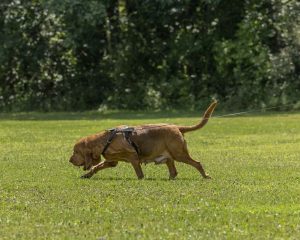
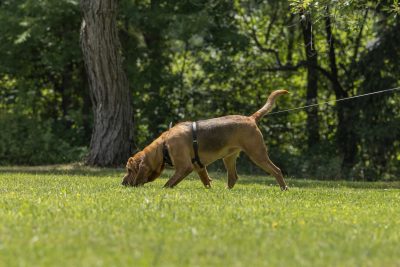
The top photo? This photo is of his mother, GCH Wychway’s Of Quartz She’s Worth It RI BCAT MTX. By Renata Canaday via Betsy Copeland
The requirement was debated before this suspension. Official RKC minutes say it was introduced at 300 yards in 2020, then reduced to 200 yards in 2021. In 2022, the Bloodhound Club argued for its removal, saying a judge or assistant could spot handler interference near the identification even if the hound remained on leash. That tells us the rule had its critics. It does not establish why the RKC chose to suspend it now; the September announcement does not give a reason.
American Bloodhound people will find some of this familiar. The American Bloodhound Club also calls the person laying the trail a runner, and its mantrailing tests ask the hound to find and correctly identify that person. You may hear American enthusiasts say “line-up,” too, although the ABC rules describe the runners’ positions rather than naming a required final stage the line-up. “Hunting the clean boot,” on the other hand, is the British expression; ABC calls its activity mantrailing.
British Bloodhound trials and American Bloodhound Club trailing both care about identifying the correct person; they don’t necessarily use the same leash rules to test that ability. In fact, ABC’s published rule requiring dogs to work on lead makes that contrast especially striking. ABC allows a lead to be dropped briefly to clear an entanglement, but not for the hound to work the trail off lead. Its rules also prohibit the handler from guiding the hound to the runner.
For now, the British change is a suspension, not a permanent repeal—and certainly not a blanket invitation to drop the leash. It’s also a good reminder of why talking to someone who actually works in a breed matters. We had the benefit of running this post by the aforementioned judge.
We learned a new phrase, nearly missed an important qualification, and came away knowing not just a little more about what these remarkable hounds are asked to do, but what they can do.