
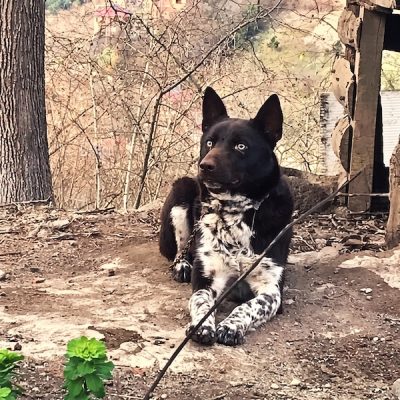
It wasn’t until we came across a study of the Zerdava in 2019 that we’d ever heard of this dog, let alone the effort to preserve it. We knew it as a dog of Turkey’s Eastern Black Sea region. There is more to its story, including a possible connection across the border in Georgia—and a claim in our original article that we want to correct.
The Zerdava is found in northeastern Turkey, particularly around Trabzon and Giresun. It is also called the Kapı Köpeği, or “gate dog,” a fitting name for a dog valued as a watchdog. Researchers say Zerdavas have been kept in the region for at least a century, though exactly when or how they originated remains unknown.
There is a Georgian side to the story. A Georgian agricultural-biodiversity catalogue describes a traditional hunting dog called the Mekverne, or Chakira, from western Georgia and notes that it is also found in what is now Turkey. Its description has striking points in common with the Zerdava: erect ears, brown-and-white coloring and an ability to hunt martens. That makes the connection worth investigating. It does not establish whether the two names refer to the same dog population, closely related populations or dogs with a shared regional history. We cannot settle that question by looking at photographs—or by assigning the dogs to one side of a modern border.
The Zerdava itself is a small to medium-sized, athletic dog with upright ears, a curved, well-furnished tail and a spitz-like outline. Its coat ranges from lighter to darker chestnut brown, often with white markings; some dogs have little brown spots on the white areas. In a 2020 study of 100 selected Zerdavas, the dogs averaged about 19 inches at the shoulder and 35 pounds. Those are averages for the dogs studied, not measurements every Zerdava must meet.
And oh those eyes! They can range from dark brown to light hazel, according to a description published by the Trabzon Zerdava Dog Association. Against that brown-and-white coat and alert little face, they are impossible to overlook. Every Zerdava photograph we see seems to have a pair that stops us in our tracks.
Traditionally, Zerdavas have worked as both hunters and watchdogs. Accounts describe their use on wild boar, foxes and jackals. Researchers who observed two dogs and interviewed local breeders reported that Zerdavas may track quietly and bark when they find game. They also described dogs pursuing martens into trees—a behavior called treeing. It is one reason the Zerdava has been compared with northern Laikas, although similar hunting behavior does not, by itself, prove a shared ancestry.
Now for a correction to our 2019 article. We wrote that a 2016 DNA study had proved the Zerdava was not a landrace, but a genetically “pure breed unto itself.” That was too strong. Trabzon Zerdava Dog Association president Serdar Ergün referred to DNA work in a 2017 news report. The genetic study available for us to examine was published in 2020. Its authors found relatively low variation among the Zerdavas they selected and concluded that the dogs may be considered a separate breed. They also found genetic groupings within their sample. The study did not prove the dogs were “purebred,” rule out calling them a landrace, or establish that they descended from northern Laikas.
“Landrace” is not a lesser or inferior status. It describes a local population shaped over time by its surroundings and by the work people needed it to do, rather than by a modern registry’s written standard. Many recognized breeds have roots in such traditional dog populations. The Basenji, for example, was established as a registered breed from hunting dogs brought from the Congo region; the Canaan Dog was developed from indigenous dogs and later gained American Kennel Club recognition. A landrace can become the foundation of a recognized purebred breed. Official recognition can give breeders a standard to work toward and the dog greater visibility and legitimacy in the wider dog world. It does not, however, create the dog’s history—or settle where that history began. The people who have lived and worked with these dogs on both sides of the border have an essential part in telling that story.
The Trabzon Zerdava Dog Association has worked to draw attention to and preserve these dogs since 2013. In 2017, Ergün said it was also seeking official recognition for the Zerdava as a Turkish breed. That effort is part of the story, but recognition and origin are different questions. What we can say with confidence is that the Zerdava is a remarkable working dog of the Eastern Black Sea region, with a history that deserves careful research on both sides of the border.