In our house, “reach and break” describes the Puli who reaches for the pot roast and breaks the cardinal rule: do not help yourself to dinner. In some Miniature Pinscher circles, however, the phrase has a far more specific—and much more elegant—meaning.
Among Miniature Pinscher fanciers and judges, “reach and break” is informal shorthand for the breed’s distinctive front action. The phrase appears in a ShowSight judging article by Miniature Pinscher breeder-judge Pamela DeHetre, who used it to describe the ideal combination of forward reach and a visible bend at the wrist. It does not appear in the official AKC standard, which instead describes those two requirements separately.images.akc+1
The AKC standard calls for a high-stepping, reaching, free and easy, hackney-like action. The front leg is to move straight forward and ahead of the body, and the foot is to bend at the wrist. The dog must also drive smoothly and strongly from the rear. That is the whole picture—front action, rear propulsion, and sound movement—not simply a dog lifting his feet high.
Reach First, Then the Break. Huh?
The reach is the clean forward extension of the foreleg. It should go ahead of the body, not merely lift toward the dog’s nose and fall back down again. The break is the visible flexion at the wrist as the foot comes forward. Together, they give the Miniature Pinscher that unmistakable animated look.
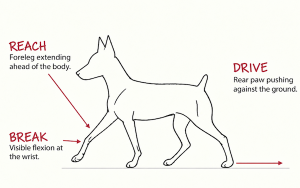
Our crude (and traced) side view….
That does not mean the Min Pin should move like a windup toy, nor should it resemble a horse with all four legs flung upward. The hackney-like action applies to the front. Behind, the dog should continue to move forward smoothly and strongly. The Miniature Pinscher Club of America’s educational material cautions that the desired action is not “true” hackney action: a mincing, inefficient gait without rear drive.
A dog may show a dramatic wrist bend and little forward extension. Another may reach well but fail to show the characteristic wrist flexion. Neither presents the whole picture. As MPCA evaluation material puts it, flashy front action alone is not enough; correct side gait includes rear drive, front reach and extension, and a pastern bend before the foot comes down.
What Makes It Possible? The Min Pin’s gait begins with construction, not with an exaggerated flick of the feet. The breed is compact and square, and its gait must remain free, easy, and balanced. The front assembly must allow the foreleg to travel forward, while the pastern must be flexible enough to permit the characteristic wrist bend. The MPCA explains that the high-stepping front action results from a moderately angled front paired with a slightly more angulated rear.
The rear is the part that makes the movement useful rather than merely flashy. A properly built Miniature Pinscher has well-angulated hindquarters, and the standard calls for smooth, strong rear drive. That propulsion carries the dog forward; it should not be confused with high rear-leg lift. The rear legs should move straight and parallel, not paddle, cross, or throw themselves about.
The front and rear must also work together. When viewed from the front or behind, the standard requires the legs to move parallel, with feet turning neither in nor out. From the side, the dog should hold a solid topline, carry head and tail high, and cover ground with animation but without wasted motion.
The Miniature Pinscher isn’t correct just because he snaps his forelegs up in front. Extreme lift, restricted shoulders, weak rear drive, or feet that fail to travel straight can turn one of the breed’s most recognizable features into a caricature. The wrist bend should be distinct, but it need not be extreme; MPCA material warns that exaggerated front action is often accompanied by a lack of soundness.
“Reach and break” is not official standard vocabulary, and we don’t mean to suggest that it is — or should be. It is, however, useful published breed commentary because it reminds us what the eye should see: a foreleg extending forward, a visible wrist bend, and a dog that is still moving ahead with purpose. Correct Min Pin movement is animated, but it is never merely ornamental foot work.
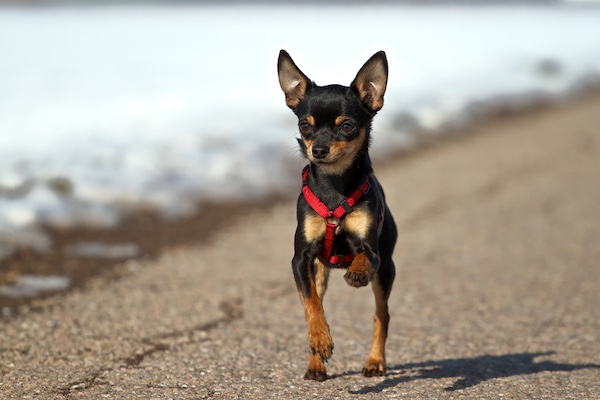
Photo by Ralf Bitzer/Dreamstime