Some critics of purebred dogs argue that when a breed’s original job disappears, there is little reason to preserve the breed itself. Consider the Otterhound, developed to hunt otters in Britain, or the Norwegian Lundehund, bred to retrieve puffins from the rocky cliffs and nesting crevices of its homeland—work that is no longer permitted in those countries. If the work is gone, critics ask, why keep the dog?
Our answer goes beyond the historical value of preserving breeds. A breed’s original purpose need not be its only purpose. The same instincts that made a dog good at one job may equip it for another—including work its earliest breeders could never have envisioned.
The Jagdterrier, a “hunt terrier by profession,” offers a different illustration of why a breed’s working heritage still matters. We found such an example in Mawhai, a dog whose hunting-terrier attributes have found an outlet in conservation.
Auckland Council identifies Mawhai as a Jagdterrier and one of the first conservation dogs trained to detect kauri dieback. This potentially fatal disease is caused by a microscopic, soil-borne pathogen that attacks kauri roots, interfering with the tree’s ability to take up water and nutrients.
Why was a hunting terrier thought to be suited to such an assignment? The FCI standard describes a breed developed with particular emphasis on hunting ability, versatility, and trainability. It calls for endurance, reliability, and pleasure in work. These are useful attributes in a dog expected to keep searching and work under a handler’s direction, whether the target is traditional quarry or something altogether different.
Mawhai’s story illustrates that distinction. His breed’s working heritage offers the foundation; he specialist training supplies the new assignment. No Jagdterrier is born knowing how to detect a plant pathogen, but the willingness to search, the stamina to continue, and the ability to learn don’t lose their value because the target has changed. Mawhai and Pip, an English Springer Spaniel, were already experienced pest-detection dogs when they received their additional training. Their existing skills simply were detoured to another target.
According to Auckland Council, Mawhai can sniff out infected trees and soil, an ability useful in screening plants and large earthmoving machinery destined for the Hauraki Gulf islands. Contaminated soil can carry the pathogen with it. Put another way, what clings to a machine can matter as much as what it carries.
It’s prudent to pause in taking Mawhai’s nose entirely on faith. University of Auckland researchers evaluated him and Pip in research-facility tests during 2021 and 2022. Their target was Phytophthora agathidicida, the pathogen responsible for kauri dieback. The university’s July 2023 report described the dogs as “pretty good” at detection, but “a long way from infallible.” The research paper judged them an “adequate first-pass detection tool.
So why continue?
The value lies in what that first-pass screening could accomplish: helping locate infected trees before symptoms appear, detecting infected soil, and checking high-risk plants and equipment. The researchers also suggested that free-ranging dogs could efficiently scan large, inaccessible areas—giving conservation teams another way to search for a threat that might otherwise go unnoticed.
Auckland Council describes Mawhai as mostly retired, though still working part-time at the waterfront. Alongside rats, mice, and other pests, his assignments have included a threat his breed’s earliest breeders could scarcely have imagined: a microscopic pathogen endangering New Zealand’s kauri trees.
That brings us back to the question: If the original work is gone, why keep the dog? Because a breed’s working heritage can offer more than its original job description suggests. In Mawhai, attributes valued in a hunting terrier have helped equip a conservation dog. His story gives us another reason to preserve those qualities—not only for the work we already know, but for work we have yet to imagine – an example of breed instinct redirected.
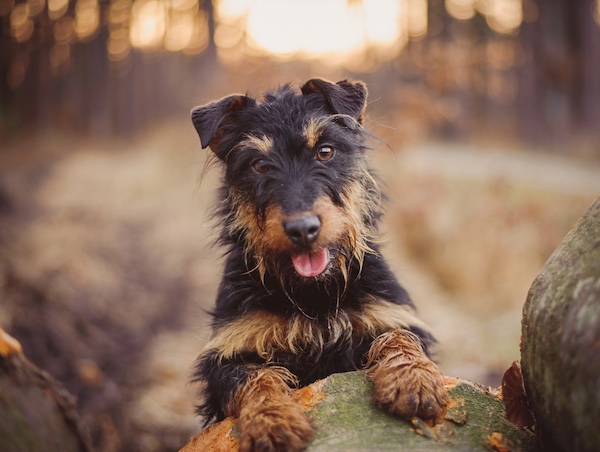
Image of a Jagdterrier (he is not Mawhai) by Snowboy Depositphotos