
In Iris DeMent’s song “Let the Mystery Be,” she considers what happens when we die:
Everybody is wondering what and where
They all came from
Everybody is worrying about where they’re going to go
When the whole thing’s done
But no one knows for certain and so it’s all the same to me
I think I’ll just let the mystery be
Iris is content to leave the question open. Others, however, have described what lies beyond in considerable detail—and sometimes with numbers attached. The Qur’an describes Hell as having seven gates. In ancient Sumerian mythology, the goddess Inanna passes through seven gates on her descent into the underworld. Dante’s Inferno has nine circles of Hell. And in Mexica (Aztec) belief, the journey to Mictlan takes the dead through eight perilous levels before they reach their final resting place in the ninth—a passage said to take four years.
In some accounts of the world beyond, the dead encounter a dog. Whether that is a comfort depends on the dog—and the story.
Dante’s three-headed Cerberus torments the gluttonous in the third circle. The dogs of ancient Vedic tradition have a more complicated assignment. In a funeral hymn in the Rigveda, the deceased is urged to pass beyond Yama’s two brindled, four-eyed dogs to join the ancestors—then Yama is asked to entrust the traveler to their protection. Watchers of the road of the dead, they are both beings to get past and guardians to depend upon.
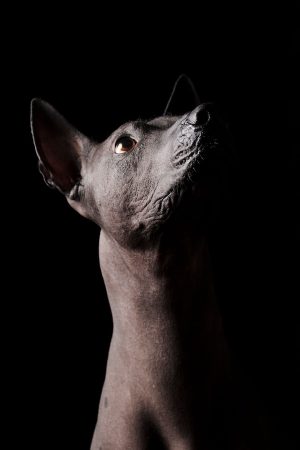
The Mexica, too, imagined a dog helping the dead complete their journey. But theirs was no four-eyed supernatural creature. It was a familiar companion: the Xoloitzcuintli.
On these pages, we have discussed the Xolo’s role accompanying souls: the creation of the dog from the Bone of Life and its gift to humanity as an afterlife guide, and the Legend of the Butterfly Dogs, but we have not addressed the moment when the dog recognizes his or her person from life.
Book 3 of the Florentine Codex describes the departed looking toward a dog across a broad river. When the dog recognizes his master, it plunges into the water to carry that person across. The extraordinary part isn’t just that the dog can cross between worlds, but that even in after life, the dog knows his person.
This comes as no surprise to today’s dog owner whose dog recognizes the sound of the car turning into the driveway, or a footstep outside the door. In the old account, that familiar recognition survives in the most unfamiliar place imaginable. The person has died. The landscape has changed. The dog still knows.
Isn’t it remarkable, giving the dog that responsibility? A human being who cannot complete the journey alone must depend upon an animal. The companion becomes the capable one. At the river’s edge, it is the person who needs help, and the dog who knows what to do.
Don’ t mistake this for an ancient version of the Rainbow Bridge. The belief belonged to a particular culture, with its own obligations and rituals, some deeply uncomfortable to modern readers. Sahagún’s account describes a dog being sacrificed and burned alongside the deceased so that it could accompany the person beyond death. The tenderness of the recognition exists alongside that harder history; telling the story honestly means acknowledging both.
Yet the detail that reaches across the centuries isn’t a description of the river’s depth or the difficulties still ahead. It is that profound of recognition. Among all the uncertainties of the journey, the dog knows who has arrived.
Cerberus makes a frightening prospect even scarier. Yama’s dogs watch the road. But the dog at the Mexica river offers something more personal than permission to pass: help from a creature to whom the traveler already belongs. With our dog there, it feels like coming home.
Iris is willing to let the mystery be. We may be, too. But if there is a river, it is comforting to imagine a familiar dog on the other bank.
Photo of a Xolo by Lorenzo Manera