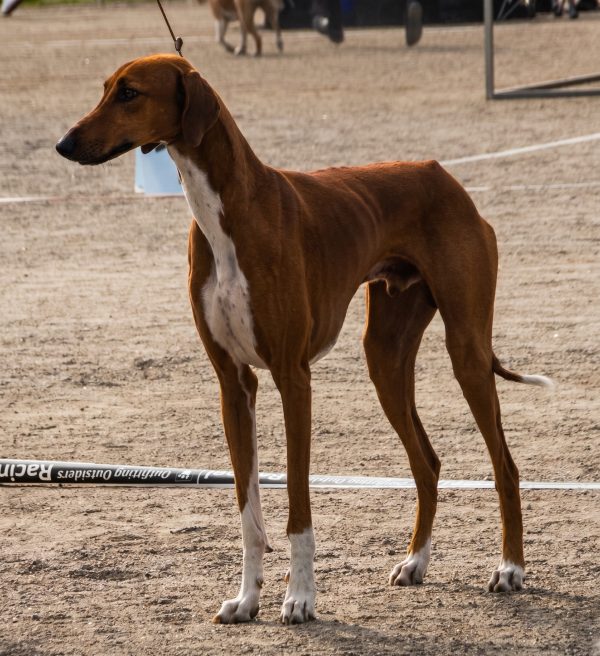
Before you reach for an extra cup of kibble to feed this dog, know this. An Azawakh’s protruding hipbones are not a flaw. They are required.
The AKC standard doesn’t merely tolerate them. It calls for hipbones that are “distinctly protruding” and positioned as high as, or higher than, the withers (from the standard: Hipbones are distinctly protruding and always placed at an equal or superior height to the height at the withers). Put another way, place them below the withers, and you have a serious fault. The FCI goes further: hips lower than the withers are disqualifying. Clearly, this is not a breed in which a little more padding necessarily improves the picture. In fact, a fat Azawakh is disturbing.
Why are the bones so noticeable?
Being lean is part of it, to be sure, but it isn’t the whole explanation. The points most of us casually call “hipbones” are part of the pelvis, and how that pelvis sits helps determine what we see. In her AKC article on sighthound condition, Denise Flaim explains that the steep placement of the pelvis in eastern sighthounds makes those bones more evident. Some of what an unfamiliar eye reads as “too thin” is actually skeletal arrangement. An extra helping of dinner won’t rearrange it.
A little anatomy helps here. The slope of the croup and the angle of the hip joint are two different things. Think of one as the slope toward the tail, and the other as the angle where the thighbone meets the pelvis. The AKC describes the croup as oblique, without an exaggerated slant. The FCI gives an ideal slope of 45 degrees. Both describe the hip-joint angle as very open—about 130 degrees. That doesn’t mean the pelvis itself sits at 130 degrees. Different measurements, different relationships.
Nor do those high hipbones mean the back must run dramatically uphill. Both standards allow an approximately horizontal topline or one that rises slightly toward the hips. The hipbones must occupy their prescribed position, but that isn’t an invitation to exaggerate the entire outline. Distinctive is correct. More distinctive is not necessarily better.
Set that framework inside a dog who is taller than he is long, add fine skin and a short coat, and there isn’t much hiding the architecture. Nor should there be. The AKC standard specifically calls for visible bone and musculature, with hipbones showing in a correctly weighted dog. This is not an outline we are supposed to feed away.
Which brings us to the question we ask a lot on these pages: Why? What did this construction do for a hunting sighthound?
The Azawakh developed among the pastoral peoples of the Sahel, with working duties that included coursing game and guarding camp. The FCI identifies gazelles, hares, and ostriches among his quarry. Whatever else we admire about his silhouette, this was a dog with work to do. This is not Madonna’s “Strike a Pose” kind of dog.
His movement belongs to that discussion. The FCI describes a springy gallop; the AKC calls it leaping. It gives the impression of a dog built to launch rather than push. At the trot, however, the AKC wants an altogether different impression: lightness, agility, and the appearance of floating effortlessly over the ground. The same conspicuous framework has to be considered in motion, not just admired—or worried over—while standing still.
And there are limits. The AKC specifies that the front foot should not extend past the nose at the trot, and faults exaggerated reach and drive or heaviness. The UKC also faults a heavy gait. Big reach and big drive may catch an eye at ringside, but they are not automatic virtues here. An Azawakh should not have to impersonate a more heavily angulated trotting breed to demonstrate that he is correctly made.
“Built to launch” describes the impression he gives, rather than a proven explanation of pelvic mechanics. The standards connect a distinctive framework with distinctive movement, but they do not isolate one pelvic angle as the reason for the breed’s speed or endurance.
Those hipbones reveal a framework the standards expressly preserve. All that said, it does not excuse poor condition: the FCI also disqualifies extreme general thinness. The standard asks us to recognize an Azawakh—not to explain away an underweight one.
Photo of a red and white Azawakh by Canarian, CC BY-SA 4.0, via Wikimedia Commons; contrast enhanced.