
NPDD has historically steered clear of news stories about the biggest or smallest purebred dog. We don’t see much to celebrate when size becomes the achievement and the dog’s health becomes an afterthought. Pushing either end of the spectrum is not a breeding goal we applaud.
We’re making an exception for a Dachshund in Buda, Texas.
She is 19 feet long, 10 feet tall and five feet wide. She is also made entirely of steel, which takes our usual objections off the table. We don’t have permission to share her image here, but you can see it by clicking here.
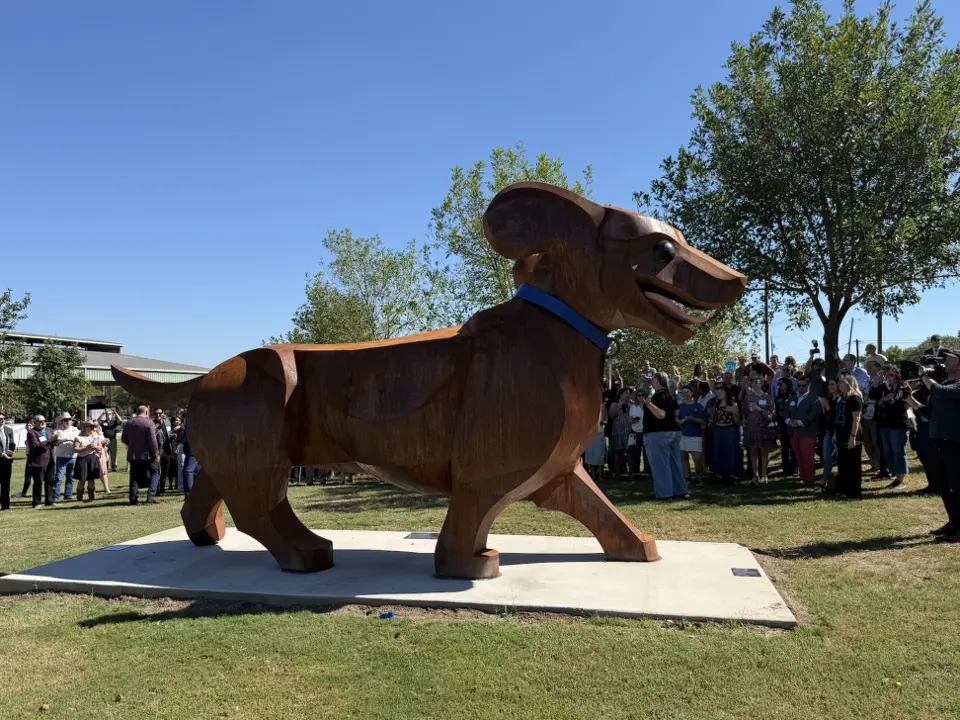
Unveiled in Buda City Park on October 10, 2026, the enormous Dachshund was commissioned to celebrate the Buda Economic Development Corporation’s 25th anniversary. The organization calls her the largest “wiener dog” in Texas—a claim we’ll leave attributed to its source rather than present as an independently verified record. Texas public-art studio Art Seen Alliance designed and fabricated the sculpture from more than 400 individually cut and shaped steel parts.
That’s a lot of Dachshund.
It is also a dog with a local connection. Buda’s Wiener Dog Races began in 1997 as a fundraiser for the Buda Lions Club, and the tradition helped give the community its identity as the “Wiener Dog Capital of Texas.” April 2027 will mark the races’ 30th anniversary. The sculpture gives that annual celebration a permanent presence in the park.
For readers whose acquaintance with Dachshunds begins and ends with the phrase “wiener dog,” there is considerably more to the breed than an amusing silhouette and a nickname that we don’t actually love (but that’s just us).
The Dachshund developed in Germany as a hunting dog, working both above and below ground. The Dachshund Club of America describes a versatile hunter capable of tracking, flushing game, retrieving and “going to ground”—following quarry into its underground refuge. Badger hunting belongs to that history. The long body and short legs were not devised to make a dog look entertaining on a greeting card. They were features of a working animal with a demanding job. It’s one of our favorite “form following functioning” breeds.
Nor does the breed’s distinctive shape mean that more length and less leg must be better. The official standard describes a muscular, balanced dog whose movement is neither awkward nor restricted. It calls for agility, freedom of movement and the endurance to perform the work for which the breed was developed. The point is a capable Dachshund, not a competition to see how far its proportions can be pushed.
Buda’s steel representative has a different assignment, but the choice to depict her in motion is a nice touch. Jennifer Storm, the economic development corporation’s CEO, told Texas Highways that she wanted the dog to look as though she were racing, with ears flying back, moving legs and the determined expression familiar to anyone who has watched the town’s races. This was to be a Dachshund doing something, not simply occupying 19 feet of park.
Even her finish will develop with time. The sculpture is made of Cor-Ten weathering steel, which forms a protective, rust-toned patina. That reddish-brown surface is part of the material’s intended character, not a sign that someone has neglected the dog’s grooming.
There is a practical purpose behind all this municipal affection. Buda EDC wants travelers on Interstate 35 to take the exit, photograph the sculpture and spend some time in town. Storm has described it as an investment in Buda’s identity, giving the community a recognizable landmark throughout the year rather than only on race weekend. Whether it delivers the hoped-for visitor spending remains to be seen; that is the intention, not an established result.
What appeals to us is the direction of the tribute. Buda did not choose an interchangeable dog and attach a civic slogan. It chose the particular breed already woven into one of its longstanding community traditions. A German hunting dog has become part of a Texas town’s story, and the town has given that connection a very large place in its park.
We’ll always pass on size records that turn living dogs into superlatives, but a 19-foot Dachshund whose size was determined in a fabrication shop rather than a breeding program? That one we can get behind.