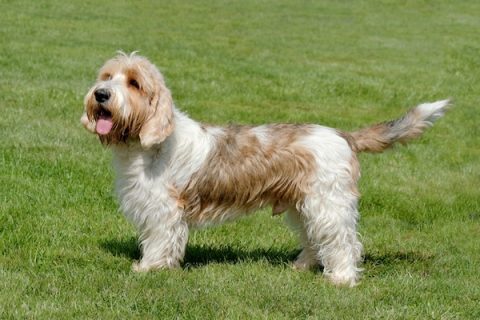
Few breed clubs have worked as hard to keep a dog looking messy as the club for the Petit Basset Griffon Vendéen, the scruffy rabbit hound from the Vendée.
Kitty Steidel, a judge and the founding president of the Petit Basset Griffon Vendéen Club of America, wrote that the club had tried phrase after phrase to describe the breed’s casual look, “hoping one of them would be observed but alas, not so.” She even once asked for no brushes in the ring at all, then gave her verdict on how that went: “Fat chance today!”
News flash: The breed standard that takes effect next year on January 1, 2027, stops describing the look and starts naming the offenses: “Sculpting, clipping, or scissoring should be penalized.”
Got that?
Why on earth would a club want a messy coat to begin with? It helps to know where the dog comes from and what its job was.
The PBGV’s name is a description in four words. Petit means small, basset means low to the ground, griffon means rough-coated, and Vendéen means from the Vendée, a region on France’s Atlantic coast. The parent club traces the breed to the sixteenth century and a larger ancestor, the Griffon Vendéen. It describes the home terrain as “thick underbrush, rocks, thorns and brambles.” The PBGV is, in the club’s words, “first and foremost, a hound developed to hunt game by scent,” and the AKC’s breed history says that game was mainly small quarry such as rabbit. Picture him working that ground: chestnut woodland and hedgerows overgrown with brambles, the countryside the French call the bocage. A small hound pushing through that cover after rabbits needs a harsh outer coat over a dense undercoat. It’s the same reason you’d wear canvas, not silk, for a walk through a briar patch. Or why we wouldn’t let a Puli in show coat get remotely near this path. Just saying.

Surkål, CC0, via Wikimedia Commons

The PBGV is old, but its paperwork is fairly new. The first president of the French breed club founded in 1907, Paul Dezamy, wrote one standard covering both the Petit and its bigger cousin, the Grand. The Petit got a standard of its own in the 1950s, but the club says the separation wasn’t really enforced until 1975.
American interest took off in 1983, when Alexander, a 90-day-old puppy, won Best Puppy in Match at a New Jersey “Super Match.” The American club formed in 1984, and the AKC granted full recognition on February 1, 1991. In 2023 a PBGV named Buddy Holly won Best in Show at Westminster, the first of his breed to do it, and gave that bearded, whiskered face its biggest stage. It wasn’t a big ask. Everyone fell in love with the scruffy mug.

Which brings us back to that hair. “Tousled” is easy to say but hard to put into rules.
The standard approved in 2014 tried hard. It called for a coat “long without exaggeration” and an overall appearance “casual and tousled.” It declared that “any sculpting, clipping, scissoring or shaping of the coat is contrary to PBGV breed type,” and that the coat “should be clean, neatened as necessary, but always remain casually disarrayed.”
The club’s judges’ education material is more vivid. It asks judges to look for “the natural trimming of coat by brush and bramble as if the dog has hunted.” It also lists what doesn’t belong: trimming all the hair off the ears, cutting off eyebrows, trimming around each toe, and “smoothing out every wisp.” The same material warns that too much coat “is a hindrance in the field and hides conformation in the show ring.”
If we understand correctly, by Steidel’s account, the message didn’t stick. “Though dandified is what you will see most often in the ring, we do not want that,” she wrote. She listed eyebrows “cut straight off like a visor,” underlines shaped like a sporting dog’s, and “terrier jackets” on the body. “Casually disarrayed,” she noted, was only the club’s “latest attempt” at a description.
The revised standard goes a different way. The AKC Board approved it on October 12, 2026, based on the club’s membership ballot. On grooming, the coat section now says only this: “The coat may be tidied but a natural appearance must be retained. Sculpting, clipping, or scissoring should be penalized.” “Casually disarrayed,” “neatened as necessary,” and “contrary to PBGV breed type” are gone. In their place are a permission (tidy) and an instruction to judges (penalize). The coat itself goes from “long without exaggeration” to “not too long and without exaggeration.” That wording is close to the FCI standard used across much of Europe, which calls for hair that is “harsh but not too long.”
All of this comes from a word-by-word comparison of the two published standards. That shows what changed but not why (our favorite question), because neither the standard nor the Board minutes give the club’s reasons. The penalty itself isn’t new. The 2014 standard ended its coat section by saying “any deviation” from the ideal should be penalized, so a judge could already fault a sculpted dog.
What is new is that a judge no longer has to connect those dots. The offenses are named, in plain words, right where the coat is described. Read alongside years of the club’s own complaints, the new text sounds like a club that has just stopped asking nicely. It’s a reasonable interpretation, not the club’s stated reason, and it doesn’t change what the text says.
What it says is still not a dress code with automatic disqualifications. The standard keeps its rule that faults are penalized “to the extent of the deviation.” The argument is made that the structure underneath coat is what matters most. A tidied dog with excellent structure can still win. It just shouldn’t win because of the scissor work. And the vision at the top of the standard hasn’t changed. The General Appearance section still asks for “rough, unrefined outlines” and a “compact, casual, rather tousled appearance.” The revision also touches the eyes, skull, bite, and hocks, but those are a story for another day.
We like to think that in a breed this old, the hedgerows and bramble of the Vendée were the first groomers, and they never sculpted anybody. The standard now asks that dogs in a show ring follow suit.
Photo of a PBGV by Capture Light/iStock