Most hobbies, sports and avocations have a language all their own. For fun, see if you can name the arena each of these ten words comes from:
Frogging
Eagle
Nuc
Googly
Nutmeg
Major
Icing
Lifer
Fat quarter
Hog line
The answers are at the end. Our little pop quiz makes the point that every interest has its own vocabulary, and the subcategories within those interests have vocabularies of their own. Dog fanciers will have recognized “major” as something a dog needs to earn its championship. Within the fancy, though, individual breeds have their own terms. Here we turn to two of them: “drag” and “wash.”
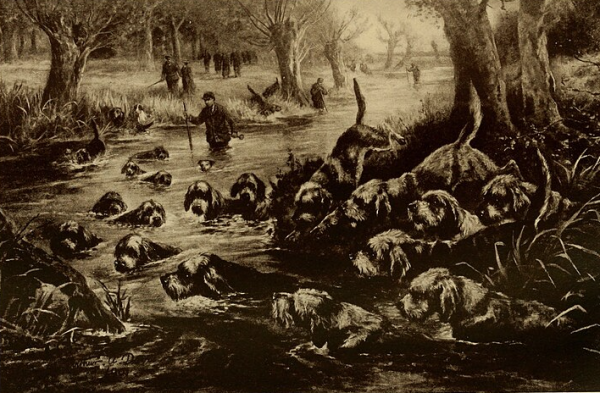
If you know your breeds, and you really know the standards from the world’s registries, you’ll have guessed that these words come from otter hunting, and that they survive in the historical summary of the FCI Otterhound standard. That paragraph tells us that when an otter’s scent is followed on land, it’s called a drag, and when it’s followed in water, it’s called a wash. The current FCI text shows how the terms are used. Frustratingly for us, it doesn’t say when they originated.
What can be said is that neither word was coined for the FCI. Both were working vocabulary on English riverbanks more than a century ago. When L.C.R. Cameron published Otters and Otter-Hunting in 1908, he included a glossary of the sport’s language. In it, a drag is “the trail of scent left by an otter, by which he is traced to his couch or holt.” Cameron had a second water word too: “ream,” the scent “coming down on the water when an otter has ‘moved.'” Writing The Book of the Otter in 1922, Richard Clapham still put “wash” in quotation marks, as if readers might need help. He described old Boatman “swimming round and round beneath the holt in an endeavour to take the scent or ‘wash.'” Drag wasn’t exclusive to otter hunters, either. It also meant the trail left by a fox or other hunted animal, and it later gave its name to drag hunting, where hounds follow an artificial scent.
The two scents needed two names because they behaved so differently. An otter fed through the night and left its drag along the banks, which is why hunts met at daybreak. Clapham explained that in the early-morning dew the drag “will lie strongly,” but by late in the day, where the sun had dried the ground, it became “very weak and catchy.” Water was harder still. The current could carry scent away completely, and an otter might cross in deep water or float downstream back to where it started. That is why Clapham could write of hounds having “some difficulty in owning the wash” even on a day when scent on land was screaming. Hounds could also run a line the wrong way, which he called “running heel.” Huntsmen checked the otter’s footprints, its “seal,” in the mud to see which way the toes pointed. Once the direction was settled, the cry was “up-water” or “down-water.”
All of that is packed into the FCI’s one sentence saying that an Otterhound can follow a drag for up to twelve hours and swim a wash for five. The same work explains the oily coat, the webbed feet and the big baying voice.
Today, it’s hard to fathom why anyone would hunt such endearing critters. To the people who lived along Britain’s rivers, though, the otter wasn’t cute. It was competition. Otters eat fish, and through the 18th and 19th centuries they were persecuted more and more to protect fisheries, as well as for sport. They were also taken for their pelts until the 1970s. Hunting with hound packs became an organized summer pastime, and intensive hunting in the 1920s and 1930s put real stress on the otter population.
Hunting wasn’t what nearly finished the otter off, however. The catastrophic decline began in 1957 and 1958, and researchers trace it mainly to organochlorine insecticides polluting the rivers. Otter hunters were among the first to notice that the animals were disappearing. By the 1970s, the hunts were killing only about five to eight otters a year across Britain. Otters gained legal protection in England and Wales in January 1978, which ended the hunting. Many packs were dispersed, and with them went the Otterhound’s original job.
The story ends better than anyone could have hoped back then. Harmful pesticides were banned, the water got cleaner, and otters came back. They’re now confirmed present in every county in England, where they had once vanished from most of the country. The words, meanwhile, outlived the work, and drag and wash survive in the breed’s own standard.
We’re not sure we can go so far as to say that Otterhounds have been totally repurposed. Owners compete in conformation, obedience, rally, agility, barn hunt and lure coursing, of course, and the breed also does therapy work and K-9 nosework. Tracking is a natural fit. and several Otterhounds have been certified as search and rescue dogs. The Otterhound Club of America even holds tracking get-togethers. But the breed is fragile. The UK’s Royal Kennel Club lists the Otterhound as a vulnerable native breed with only 10 litters registered in 2025, and just three in 2026 so far as we can tell.
Answers
- Frogging — knitting: ripping out rows of stitches to undo a mistake. The name is a joke: “rip it, rip it.”
- Eagle — golf: finishing a hole two strokes under par.
- Nuc — beekeeping: short for “nucleus colony,” a small starter colony with a queen and a few frames of bees, used to start a new hive. Pronounced “nuke.”
- Googly — cricket: a delivery that looks like it will spin one way and then spins the other. It’s the bowler’s trick ball.
- Nutmeg — soccer: passing or dribbling the ball straight through an opponent’s legs.
- Major — AKC dog shows: a win worth three or more points toward a championship. A dog needs two majors, won under two different judges, among its fifteen points to earn the title.
- Icing — ice hockey: shooting the puck from your own side of the center red line all the way across the opposing team’s goal line without anyone touching it. Play stops, and the face-off comes back to your end.
- Lifer — birdwatching: a bird seen for the very first time in your life. It goes on your life list.
- Fat quarter — quilting: a quarter-yard of fabric cut wide, 18 by 22 inches, instead of in a long strip, giving quilters a usable, square-ish piece.
- Hog line — curling: the line a thrown stone must fully cross at the far end of the ice. If it doesn’t, and it hasn’t hit another stone, it’s taken out of play.
Image: Otterhounds. From The Hunting Field with Horse and Hound in America, the British Isles and France by Frank Sherman Peer, 1910. Public domain via Wikimedia Commons.