
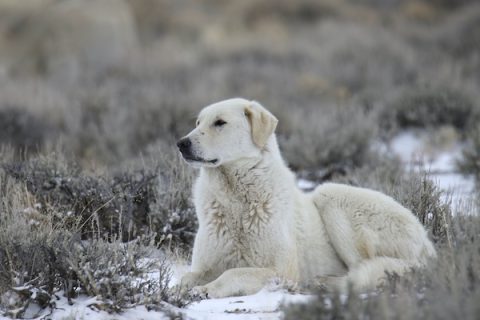
Readers of a certain age will remember when a friend pulled you aside and whispered, “Your roots are showing,” as an act of kindness. Mon Dieu, c’est affreux, you think. And a sliver of dark at the part? Time to call the colorist as no self-respecting woman wanted anyone to know that she colored her hair. Times change, but Kuvasz people look at roots differently. In this breed, what lies under the white is supposed to be dark, and the darker, the better.
The AKC standard says very little about color, and it says it plainly: “White. The skin is heavily pigmented. The more slate gray or black pigmentation the better.”
In its judges’ guide, the Kuvasz Club of America describes the ideal Kuvasz as “a dark-skinned dog with a white coat.” The FCI standard, used in Hungary and the other FCI member countries, goes further. It calls for skin that is “well pigmented, slate grey and tight,” with a black nose, black eyelid rims, and black lips. A lack of pigment on the nose, lips, or eye rims is a disqualifying fault.
Why should a white dog have dark skin? The breed standards require it without explaining it, but we suspect the most likely reason is sun protection. A large white guardian working outdoors with its flock would be better protected by dark skin than by pink, especially since the AKC standard notes it is natural for the Kuvasz to “lose most of the long coat during hot weather.” The AKC says dogs with white or thin coats, light-pigmented noses and eyelids, or hair lost to seasonal shedding are more at risk for sunburn.
In the show ring, much of a Kuvasz’s pigment is obvious at a glance: the black nose, lips, and eye rims stand out against all that white. The coat is harder to judge, especially under the different lights under which we show our dogs. The AKC standard calls for a dog “white in color with no markings,” but the parent club reminds judges that white comes in many shades, and that lighting, coat texture, soil stains, coat care, and parasite-control products can all change how a coat looks.
To see past all that, judges are asked to part the coat “to help determine the true color near the roots.”The roots are where the truth lies.
The club also cautions judges to guard against treating whiteness as more important than structure, soundness, or temperament. AKC judge Agi Hejja was chair of the club’s Judges Education Council when its 2023 guide was published. Her involvement with purebred dogs began in her native Hungary in 1969, with the Kuvasz as her first breed. She puts it simply: “The judge should part the hair to determine the true color of the coat. There are different shades of white and stains can occur.”
Now for the surprise!
Part enough Kuvasz coats and someone will eventually find a black hair. The Kuvasz Club of America says so directly: “You may find black hair on a Kuvasz. At one time they were different colors. Selective breeding has removed the colored dog from the gene pool.” Writing in ShowSight, Lynn Brady and Connie Townsend point to a turning point. By 1935, 1,700 Kuvasz were registered in Hungary, and around that time the standard was revised by Mr. Abonyi, vice president of the Hungarian All Breed Kennel Club and director of the Budapest Zoo, and Dr. Marki, a veterinarian. After that, “Dogs with reddish, wolf-gray, or black [coats] were no longer acceptable.” White also served a practical purpose. According to the parent club, a light-coated dog was easier to tell apart from predators, and that “served the shepherd well in the dark when the livestock were attacked.”
So a stray black hair is a reminder of the breed’s past, not a scandal. And unlike the rest of us of a certain age, a Kuvasz never has to hide its roots.
Image: Kuvasz by Nancy Strohm/dreamstime