Readers rarely ask why NPDD sometimes writes about standards from outside the United States, but the question deserves an answer. The world is shrinking, and acquiring or breeding to a dog from another country is getting more common. If one intends to show such a dog or breed to it, it’s good to know whether that dog’s attributes are a good fit in a breeding program, and whether it adheres to the AKC standard.
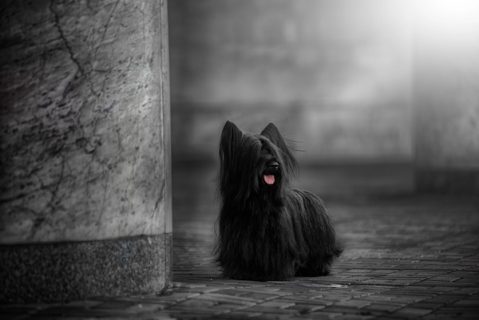
The Skye Terrier’s ears show why. Both the AKC and FCI standards allow prick or drop ears, and both say the drop ear is the larger of the two. The FCI calls the prick ear “not large” and the drop ear “larger.” The AKC calls the prick ear “medium in size” and the drop ear “somewhat larger in size.” Only the AKC says where the ear belongs on the head: prick ears are “placed high on the skull,” while drop ears are “set lower.”
The FCI’s wording goes back a long way. When the FCI amended its Skye Terrier standard in September 2026, the changes, printed in bold, dealt with color, and the ear section was left alone. That section reads almost word for word like the description published by the Skye Terrier Club of Scotland more than a century ago, which Robert Leighton reprinted in Dogs and All About Them. Prick ears were “not large, erect at outer edges, and slanting towards each other at inner, from peak to skull,” and pendant ears were “larger, hanging straight, lying flat, and close at front.” Neither version says a word about set.
So why should a prick ear sit high and a drop ear lower?
The standards don’t say. The closest thing we found to an explanation comes from an essay written around 1988, in which AKC judges Donna and Nolan Dale wrote that “the set of the ears is dependent on the strength of the head,” and that “the ears are set wider on a Skye with a stronger backskull.” They asked judges to picture a clock face. In their view, a correctly set prick ear falls between ten minutes to two and five minutes to one, roughly where the hands point at 10 and 2, or at 11 and 1. “A quarter of three,” with the ears out at 9 and 3, “is definitely a problem.” Writing in ShowSight, Karen L. Sanders put it more firmly: ears “should never be set on the required strong Skye head at less than 10 to 2 on a clock face.”
The drop ear has its own standard to meet. The Dales wanted it to hang flat “as a ‘hound ear,'” with “almost an entire absence of erectile power,” and they warned that “some dogs are shown as drops who are really prick ears that didn’t make it.” Longtime fanciers may notice that opinion has shifted over the years. Leighton wrote that a drop-eared Skye, when excited, pricked its ears forward “in exactly the same fashion as those of the Airedale Terrier,” and that “a houndy carriage of ear” was “a decided defect.” Today’s AKC standard simply asks that drop ears “hang flat against the skull.”
With either ear type, the ear is meant to be seen. The AKC describes the long feathering “surrounding the ears like a fringe and outlining their shape,” and the FCI says the fringe allows “their shape to appear.” When we were lucky enough to include a Skye Terrier in a video we shot back in 2015, we came away with a new appreciation for how much ear lies under all that hair. Judging set means looking at the ear, not the hair around it.
Then there’s the matter of where a Skye comes from. According to the Skye Terrier Club of America’s judges’ education primer, most early Skyes were drop-eared, and from 1890 on, erect ears grew more popular. The Skye Terrier Club in Britain says drop ears seldom appear on the European continent. A Skye imported from continental Europe is more likely to be prick-eared, and its home standard says nothing about where on the skull that ear should sit.
So for anyone bringing a Skye home from abroad, the question isn’t only whether the ears stand up or lie down. It’s where they sit.
Image: Skye Terrier by Sabo4ka/Depositphoto