First-time buyers of a particular breed sometimes wonder why their sweet new puppy was placed as a companion rather than a show prospect. What did the breeder see that they didn’t? Sometimes, the distinction comes down to something a pet owner would never think to notice.
Like ears.
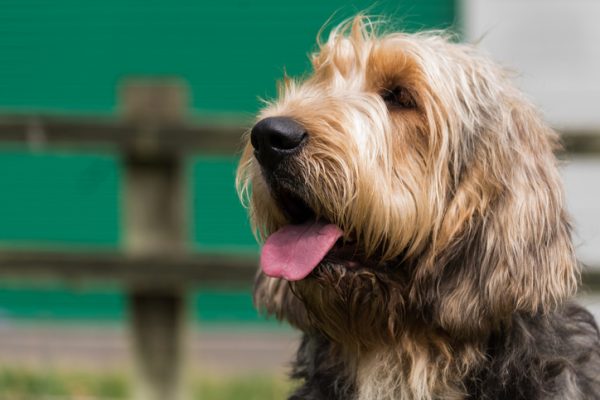
Which brings us to the Otterhound, whose correct ear is considerably more than a long, hairy flap.
The AKC standard describes ears that are long, pendulous, and folded, with the leading edge folding or rolling to produce a draped appearance. Set at or below eye level, they hang close to the head, and the ear leather—the flap itself, not its hair—must reach at least to the tip of the nose. Length alone, in other words, isn’t enough.
That drape deserves a closer look. An Otterhound’s ear should not hang like a flat sheet. Its leading edge turns into a fold or roll that gives the ear its characteristic shape. The Otterhound Club of America’s illustrated standard specifically faults flat or “pancake” ears, along with ears that are too short or set too high. A puppy can have wonderfully long, hairy ears and still lack the construction the standard requires.
And no, “hanging close to the head” and “not flat” aren’t contradictory instructions. One describes where the ear hangs; the other describes its shape. An ear can lie close to the head while retaining its fold and drape.
Why be so particular? Because the parent club connects this construction to three practical benefits for a hound whose work took it through water and rough country.First, protection. The club explains that the fold helps protect against injuries in the field. The leather should be heavy, thick, and supple, rather than thin and lightweight. Suppleness matters: the desired ear isn’t stiff, but neither should it be so delicate that briars and brambles can readily tear it. Its covering of hair supplies additional protection.
That covering has its own requirements. The club cautions against feathering like that of an Afghan Hound or Cocker Spaniel. More flowing hair isn’t necessarily better, any more than thinner, velvety leather is better. The aim is an ear suited to the work, not the most luxurious ear to run through one’s fingers.
Second, the club credits the fold with allowing air circulation and helping the ears dry after swimming. For a dog expected to move between water and land, drying afterward is a practical consideration, not a cosmetic one. That does not establish that the fold prevents ear infections; the club’s explanation concerns circulation and drying.
Third, scenting. According to the club, the ear’s length, combined with its drape and fold, helps funnel scent toward the nose as the hound works. It is the combination that matters—not a claim that the fold alone supplies a superior sense of smell.
There is another wrinkle for anyone studying these ears: their position can change with the dog’s mood or circumstances. The club notes that a relaxed or warm Otterhound may carry its ears folded back, while an excited one can pull them quite high. Momentary carriage and anatomical ear set are not the same thing.
Both AKC and FCI preserve the defining construction. AKC calls the ears “an essential feature” and requires the fold and drape. FCI specifies that the leading edge folds or rolls inward, calling the resulting draped appearance “an essential point not to be lost.” Neither standard is asking merely for long ears.
None of this makes a companion puppy less lovable, but it does help explain why a breeder looks beyond an appealing expression. Where a new owner sees an irresistible pair of ears, the breeder may be assessing length, set, substance, fold, and drape—and how faithfully those details preserve a working Otterhound.
Photo of an Otterhound by LourdesPhotography/iStock