The turning radius of our beloved old 1976 Volvo wagon (and dog show chariot) was nothing short of amazing. For a heavy station wagon, we could maneuver into surprisingly tight spaces without making a three-act production of it. You didn’t hear this from us, but we may have been guilty of showing off a little while parallel parking, though if we hadn’t packed the car for a dog show ourselves, backing up required a little more attention to what we could—and couldn’t—see around the crates. Sadly, x-ray vision is not our super power.
We’re in a “newer” old Volvo now, but we still appreciate that old wagon’s maneuverability. Clever segue alert: We also appreciate maneuverability in a Boxer who can manage turns, obstacles, and backing up with a cart attached. We at least had mirrors and rack-and-pinion steering with power assistance. The Boxer has to listen.
We’re talking about carting, also called drafting, in which a dog works in harness to pull a cart under his handler’s direction. Moving the cart forward is the obvious assignment. Getting it where it needs to go requires a few more skills—and that is where this becomes a post about teamwork rather than simply strength.
The American Boxer Club’s overview describes turns, changes of direction, and backing up among the maneuvering exercises. The challenges increase at higher levels, with off-lead heeling through serpentine courses and tasks performed over and around obstacles. There is more to this than hitching up a game Boxer and pointing him down a path. The dog has to respond to directions while pulling a cart that takes up more room than he does. Clearing an obstacle with his own body is only part of the job; he has to leave enough room for the cart’s wheels to clear it, too. Clearing an obstacle with one’s own body is only part of the job; the cart needs room to clear it, too. Backing adds another challenge: The Boxer must move in reverse with the equipment rather than simply turn around and head the other way. Strength gets the cart moving. Attention and coordination help get it where it belongs
Interestingly, the club introduces added weight after describing those maneuvering challenges. Its overview is not a universal training sequence or a complete rulebook, but the distinction is worth noticing: Moving a load and maneuvering a cart are not the same assignment. A dog who can pull enthusiastically still has to respond when the instructions call for something other than full steam ahead.
Basic obedience and stability are part of a beginning drafting test, according to the club, which notes that tests commonly take place in public parks on busy weekends. The surroundings need not come to a standstill just because a Boxer has a job to do. Remaining attentive to the handler is a big part of the task. Little wonder that the club calls carting a team-building activity.
Note that this a not a Boxer-only pursuit. The club describes drafting and carting as sports open to all breeds, though anyone interested in participating should consult the rules of the organization conducting the test for specific requirements. The overview does not establish particular titles, required loads, or backing distances.
As we see it, the appeal is a working dog using both his body and his brain, with a handler responsible for giving useful directions. In other words, the handler has to use their brain, too.
Our Volvo could manage an impressive turn, but it never once backed itself into a parking space because we asked nicely. Whined a little, but not asked.
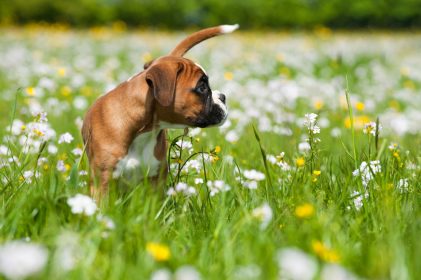
Photo of a Boxer puppy by Judithdz/Deposit