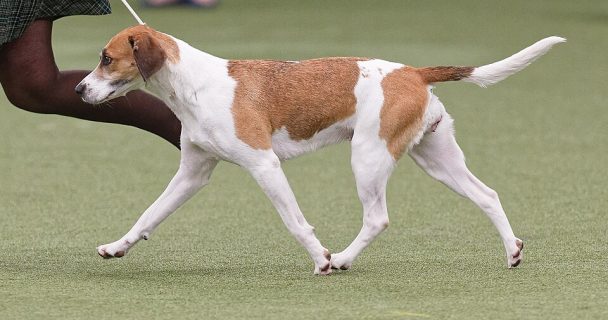
Ask a roomful of dog people to describe a Harrier’s feet, and those who know a little about the breed will say “round and catlike.” And then usually stop there. That’s true, but the Harrier standard doesn’t give the front and the rear identical instructions.
Read the Forequarters section and you’ll find feet that are round and catlike, with toes set close together and turning slightly inward. Move back to the Hindquarters and the wording changes. The feet point straight ahead. Same breed, same sort of foot, different directions.
That matters because it’s easy to carry one rule from one end of the dog to the other. A standard is a whole document, and each section has to be read on its own terms. The word “slightly” is doing real work here, too. It describes the toes, and the standard calls for good straight legs, so it isn’t a license for a front that turns in more than the standard intends. The gait section says only that a slight toeing-in of the front feet is acceptable.
The standard also tells us something about the Harrier’s build. The stifles are only moderately angulated, because endurance matters more than pure speed. This is a hound meant to keep going for long hours behind the pack, not one built for a short sprint. The breed’s structure follows that job.
The front and rear do different work, so the standard doesn’t ask for the same thing from both.
Front end: The front paw carries at least 60 percent of a dog’s weight, and possibly closer to 75 percent in some breeds. The front is also the steering mechanism and the brakes, and it takes the impact of landing.
Rear end: The hindquarters are the engine that drives the dog forward.
Pads: Both the Forequarters and Hindquarters sections call for thick, well-developed pads. Thick, well-built pads absorb shock and increase endurance, which matters in a hound expected to work tirelessly for long periods.
The standard asks for reach and drive in harmony, a dog that moves in a straight line without crabbing, and a side gait that is smooth, efficient, and ground-covering. No single angle or foot position delivers that. It comes from the whole running-gear package working in balance.
We didn’t find an expert source that explains why the front toes are allowed to turn slightly inward. The AKC breed article says only that this is acceptable but not required. We won’t guess at a reason, and “slightly” is the limit. If any readers can explain it, we’d like to know.
Photo of Evforce Miss Havoc at Henissy by Evforce shared under Creative Commons Attribution-Share Alike 4.0 International license