The surreal artist, Rene Magritte, must appeal to filmmakers as at least one movie and one mystery miniseries made his art, or the artist himself, their focus.
A 2025 Belgian miniseries, This Is Not a Murder Mystery, features a young René Magritte who, at a 1936 surrealist exhibition in Sussex, wakes beside a murdered woman with no memory of the night. He must solve it himself to clear his name, in a whodunit where, true to his paintings, nothing is what it seems. Even the series title riffs on his “This is not a pipe.”
In the 1999 remake of The Thomas Crown Affair, bored billionaire Thomas Crown, played by Pierce Brosnan, steals a Monet from the Met. But it’s Rene Magritte’s The Son of Man that runs the film: in the climax, Crown floods the museum with dozens of men dressed as the bowler-hatted figure, vanishing into his own decoys while he returns the painting….sort of (it’s an entertaining movie worth a watch for adults).
Magritte’s real life included a lesser-known supporting cast: his Pomeranian.

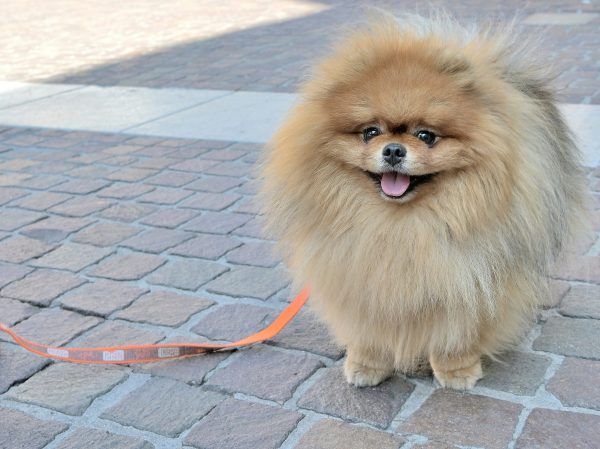
Not Magritte’s dog; photo take by Massimo P using a NIKON CORPORATION, NIKON Z50_2
Suzi Gablik, in her Smithsonian oral history, remembered stepping off a freighter in Antwerp to find René, his wife Georgette, and “their little Pomeranian black dog Lulu” waiting for her (the spelling is hers; the dog is usually written “Loulou”).
Loulou wasn’t the only one. The Magrittes had no children, but they had dogs, and the dogs were Pomeranians. Xavier Canonne, a Belgian art historian and Surrealism expert, counts four over the years. Canonne directs the Musée de la Photographie in Charleroi and curated the exhibition René Magritte: The Revealing Image. In an essay on Magritte’s life, he lists a Loulou, two Jackies, and then another Loulou, and describes them as black, brown, white, and black again. Jackie, the third, is the dog Magritte painted in Le Civilisateur. If you read other accounts, the count may differ, so we’d guess at least four.
Why a Pom? We never found a source that explains it. We found no record of how the couple got their first one, or why they chose the breed. Even the breed’s name isn’t settled: Sotheby’s describes the dog in Le Civilisateur as a “Pomeranian-Spitz.”
What is revealing to us is that the dogs were part of the household. When the Museum of Modern Art organized his 1965 retrospective, Magritte’s main worry was whether Loulou could fly and stay in his hotel. The Belgian airline made an exception, and Magritte crossed the Atlantic with his dog.
A Pomeranians also made it into his work. Magritte painted Le Civilisateur, a portrait of Jackie, three times: twice on canvas in 1944, then again as a gouache in 1946. In the first, the dog sits in front of a temple with the air of an emperor. In the 1946 gouache, a forest shaped like a castle stands behind the dog. Sotheby’s calls the 1946 version the third work to show Jackie and the most accomplished of the series. According to Canonne, Jackie was also the third Pomeranian the couple had. Sotheby’s ties the first version to a June 1944 letter: Magritte said animals showed real life better than the world run by statesmen.
Paul Simon’s 1983 song “René and Georgette Magritte With Their Dog After the War” was inspired by a photo of the couple with their dog.
The writer Kathleen Rooney later wrote a book from the dogs’ and Georgette’s point of view.
That may explain why filmmakers keep coming back to him. His images are simple and carry their own joke: a bowler hat, a pipe that isn’t one, a dog with the air of an emperor. His life was ordinary, and he put the impossible into it. It seems to us that a director doesn’t have to explain much when the visuals already do the work.
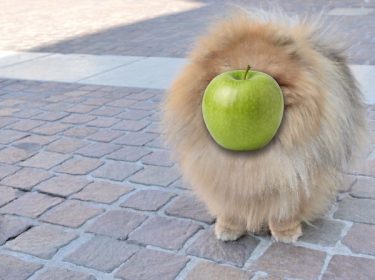
Original photo: Pomeranian by Massimo P on Unsplash; apple edited in Canva.