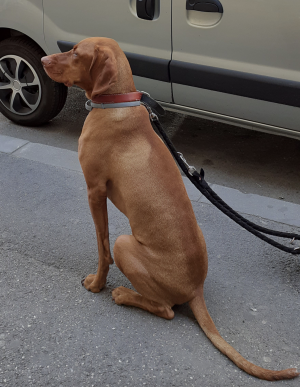
The AKC standard describes the Vizsla’s color as golden rust in varying shades, noting that lighter shadings over the sides of the neck and shoulders, giving the appearance of a “saddle,” are common. Most of us simply call this “a saddle,” though some breeders refer to it as “wings.” In the Vizsla Club of America’s judges’ education materials, it gets a more formal name: the Esterhazy Saddle, placed along the sides of the neck, shoulder, and withers, and most visible when viewing the dog from behind.
What is the origin of that name? In “All That Glitters Is Gold,” a July 2023 AKC Gazette breed column later reprinted in Vizsla News, Jamie Walton may have found the answer. The Esterházys were a powerful Hungarian noble family who rose from minor nobility to Counts and Princes, and by the 18th century were among the greatest landowners in the country. According to Walton, they were avid hunters who selectively bred their dogs, guarded the Vizsla jealously, and kept the “yellow pointer” pure while sharpening its field ability. Walton raises the same question we raised to ourselves: did the family intentionally breed for the saddle as a visual trademark of their own kennel lines, or was it simply a natural trait that showed up on its own? As Walton notes, there is likely no way to know for certain.
Walton ends the column with a memorable detail. In a Budapest museum exhibition, Walton found an actual Esterházy saddle made of leather and decorated with gold and blue-green turquoise inlay on the pommel and cantle, and thought it looked uncannily like the marking on Walton’s own dog. It makes a great story. Still, it’s probably prudent to treat the story as theory, and not documented breed history, since thus far we’ve not found evidence of who coined the term or even when.
Note the word “common” we used in the first sentence. The standard treats the saddle as ordinary variation, but it draws clear boundaries around color. Solid dark mahogany and pale yellow are both faults. White extending onto the shoulders or neck is a disqualification, though white from aging or scarring is not to be faulted. In practical terms, a saddle that stays within golden rust is fine, whereas one that fades toward pale yellow is a fault even if it isn’t white. When evaluating a dog, the ideal environment in which to check the coat is in natural light, and then to ask oneself a simple question: is that a softer shade of rust, or is it white?
What actually causes the lighter shading, anyway? As far as we can tell, Vizslas are fixed for recessive red at the E locus (MC1R, e/e), and Schmutz and Berryere’s 2007 review lists a gold Vizsla as e/e, b/b. Because e/e switches off black-brown eumelanin in the hair shaft, every hair on a Vizsla carries only red-yellow phaeomelanin. (The breed’s brown nose, eye rims, and pads come from the B locus, TYRP1 b/b, which modifies eumelanin in the skin.)
That points away from the usual suspects. In breeds like the Beagle or German Shepherd, a saddle is a dark eumelanin pattern over tan, and those patterns are associated with the agouti locus (ASIP). In a dog that is e/e at MC1R, the coat makes no dark pigment, so an agouti-type pattern would not be expected to show. That makes an ASIP explanation unlikely for the Vizsla saddle, though we didn’t find a study that tests it. Nor is this white spotting, which results from a localized absence of pigment-producing cells rather than a lighter concentration of pigment. What remains is a local difference in how much phaeomelanin is deposited into the hair.
A fair amount about the genetics of red intensity is actually known. A 2021 study found five genetic variants that together explain over 70% of pheomelanin intensity variation in purebred and mixed-breed dogs. One of the best known is MFSD12 (the I locus), where a variant identified in 2019 dilutes phaeomelanin to cream or white. That kind of extreme dilution isn’t what we are seeing in a pale patch on a rust dog, and it hasn’t been studied in Vizslas.
Those intensity studies scored coat color at a standardized location on the body. They tell us what makes a dog’s overall red richer or paler, but not why the hair over the shoulders and neck shades differently from the back. We haven’t found published research pinpointing the genetics of the Vizsla saddle, so we won’t even guess at a gene. As far as we can tell, nobody has shown one.
A pale saddle doesn’t change what matters most in the breed: structure, movement, and temperament. Look at the whole dog, and judge those first.
Image: A Vizsla in Bucharest, Romania with lighter shading over the shoulder and sides of the neck by shared under the Creative Commons Attribution-Share Alike 4.0 International license.